Platform Catalog
The platform keeps its own data catalog in PostgreSQL. It records the datasets
every connection can see, their columns, the glossary, tags, domains and data
products, and the curation written on each. It is the semantic layer wherever
the platform has a database: table enrichment, search over catalog datasets,
glossary lookups and lineage all read from it. No external catalog or ingestion
job is involved.
What is cataloged
A dataset belongs to the connection that sees it. The same table reached through two connections is two datasets, and a persona sees a dataset only if its connection rules allow that connection.
| Connection kind | Datasets | Columns |
|---|---|---|
trino |
every table and view, read from each catalog's information_schema |
each column with its type and whether it allows nulls |
api |
every stored OpenAPI operation | none |
graphql |
every query and mutation in the stored schema | each argument, with its type |
| registered and webhook tables | recorded when the registration is made, before the call returns | the columns the registration declares |
The system catalog and every catalog's information_schema describe the
query engine rather than data, and are never cataloged.
References
A catalog entity is cited and fetched with an mcp: reference:
| Reference | Names |
|---|---|
mcp:dataset:(kind,connection,path) |
a dataset. The connection is its instance name; the path is the dotted name the connection uses: catalog.schema.table for Trino, the operation id for an API, query.<field path> or mutation.<field path> for GraphQL. |
mcp:column:(kind,connection,path,column) |
one column of a dataset |
mcp:schema_document:(kind,connection,filename) |
an API or GraphQL connection's schema document |
mcp:glossary_term:<id>, mcp:glossary_node:<id>, mcp:domain:<id>, mcp:data_product:<id> |
a definition, by the id it is stored under. The slug works in place of the id when reading, and renaming a definition changes no reference to it. |
mcp:tag:<name> |
a tag |
A part of a dataset or column reference that contains ., ,, (, ) or "
is double-quoted the way SQL quotes an identifier, with an inner " doubled:
mcp:dataset:(trino,warehouse,hive.sales."orders.v2").
fetch dereferences every form. A dataset comes back with its type, the
schema document it was read from when it has one, its columns in order with
each column's curation, every aspect written on it, and the lineage
edges within three hops upstream and downstream of it.
Curation
Curation is stored as aspects, each written, versioned and rolled back on its own:
- on a dataset or a column: description, tags, glossary terms, owners, domain, custom properties, structured properties, documentation links
- on a dataset only: curated queries, incidents, context documents
- on a glossary term, glossary node, domain, data product or tag: description, owners, custom properties, documentation links
Every write records who made it, when, and the value it replaced. Rolling back a change restores that value and is recorded as a change of its own. A scan never touches curation: redeclaring a dataset keeps the curation of every column that is still declared.
Curation is written with apply_knowledge (its default sink, catalog): the
changes of one apply are written in one transaction, recorded as a changeset,
and a rollback restores every aspect the apply wrote, refused when one of them
has been written again since. An apply that finds an aspect it read written by
someone else before its own write lands reads and plans again, so two applies
to one entity at once both land. See Governance.
A promoted call record becomes a curated query on every dataset its statement
read.
A knowledge page cites a catalog entity by its mcp: reference, in its
references or its body, and the citation is checked against the catalog when
it is written.
Schema documents
An API connection's OpenAPI spec and a GraphQL connection's schema (as SDL) are
kept in the catalog, one per connection, addressed as
mcp:schema_document:(kind,connection,filename), for example
mcp:schema_document:(api,billing,"openapi.json"). Each operation's dataset
names the document it was read from: fetch on the dataset lists it as a
reference, and its schema_document field holds it. A scan records a new
version only when the document's content or media type changed, so an
unchanged spec stays at its version.
A document belongs to its connection. fetch returns it only to a caller whose
persona may reach that connection, the rule its datasets are read under, and
answers not found to anyone else. Its text is the body, up to the 1 MiB every
fetched file is held to; a longer one is cut at a character boundary with a
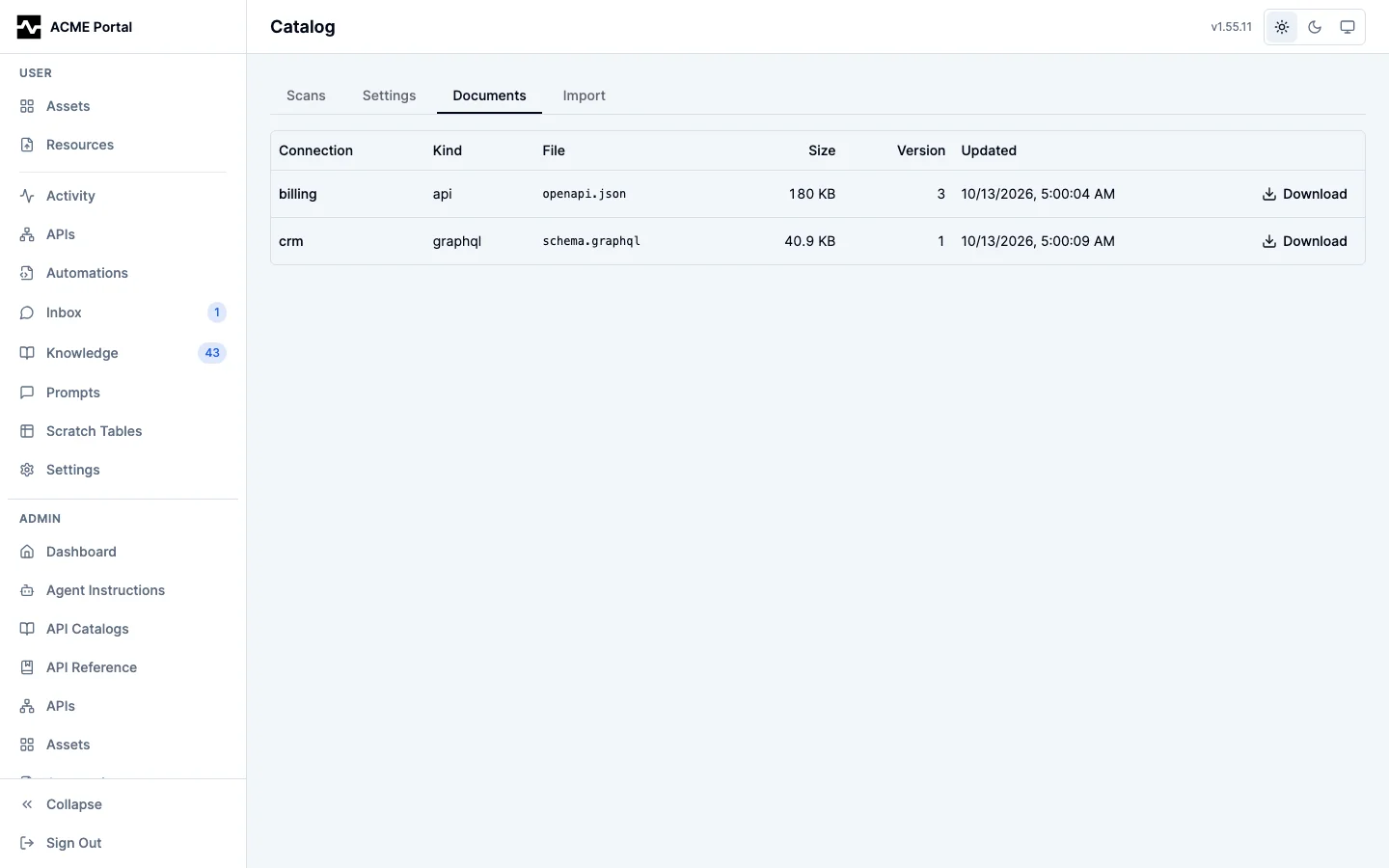
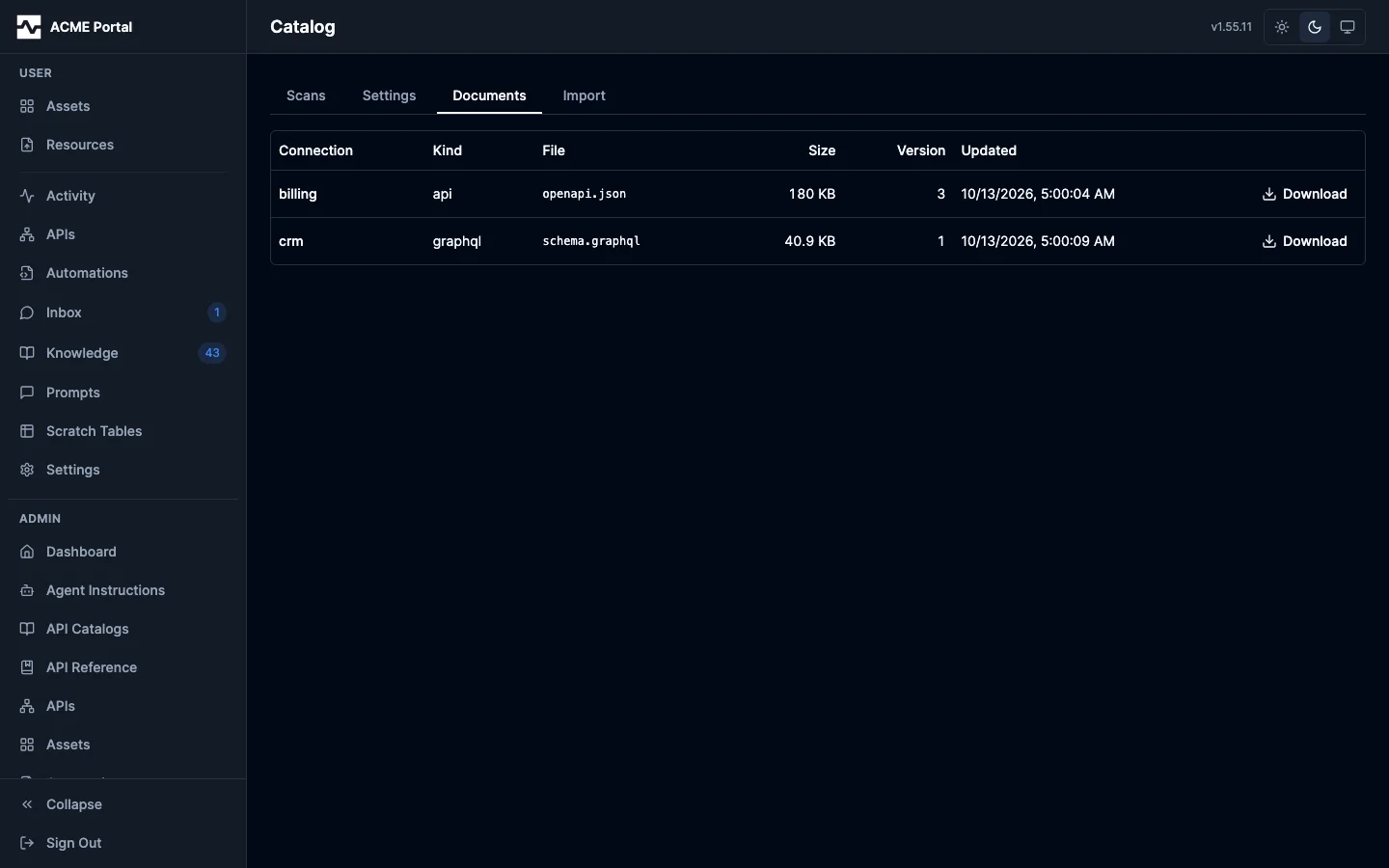
note saying how much was shown. An administrator lists every document on
Admin > Catalog > Documents, or with GET /api/v1/admin/catalog/documents,
and downloads one from there. A knowledge page may cite one. A page's citation of a schema document, a dataset or a column is listed, by fetch and on the portal, only to a reader whose persona may reach its connection; another reader's fetch counts it in references_withheld.
Scans
Every connection is scanned every 6 hours by default, and once when the platform starts if it has never been scanned. A scan writes what the connection sees and marks every dataset it no longer sees as removed. A removed dataset's curation stays readable, and a later scan that sees it again clears the mark.
A Trino catalog that cannot be read, for example because its connector is broken, does not fail the connection's scan. The scan writes the catalogs it could read and reconciles them as usual, records the unreadable catalog as unread with the reason, and marks nothing in it removed: what it did not read is not evidence that it is gone. A scan that cannot list the connection at all, or cannot write to the catalog, fails and marks nothing removed.
Replicas take turns: one advisory lock guards the scan, and the time of the last scan any replica started decides when the next one is due.
Admin > Catalog
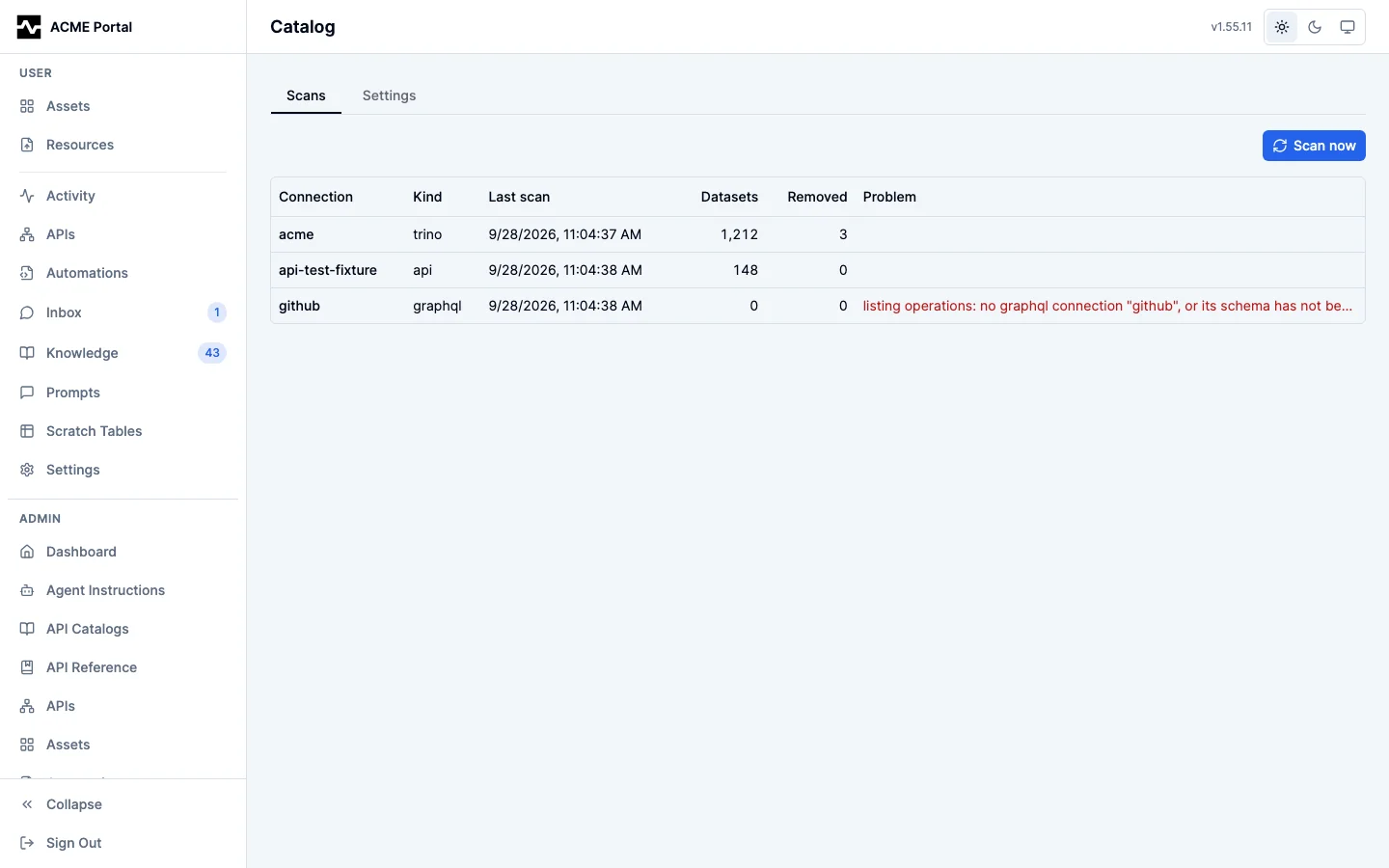
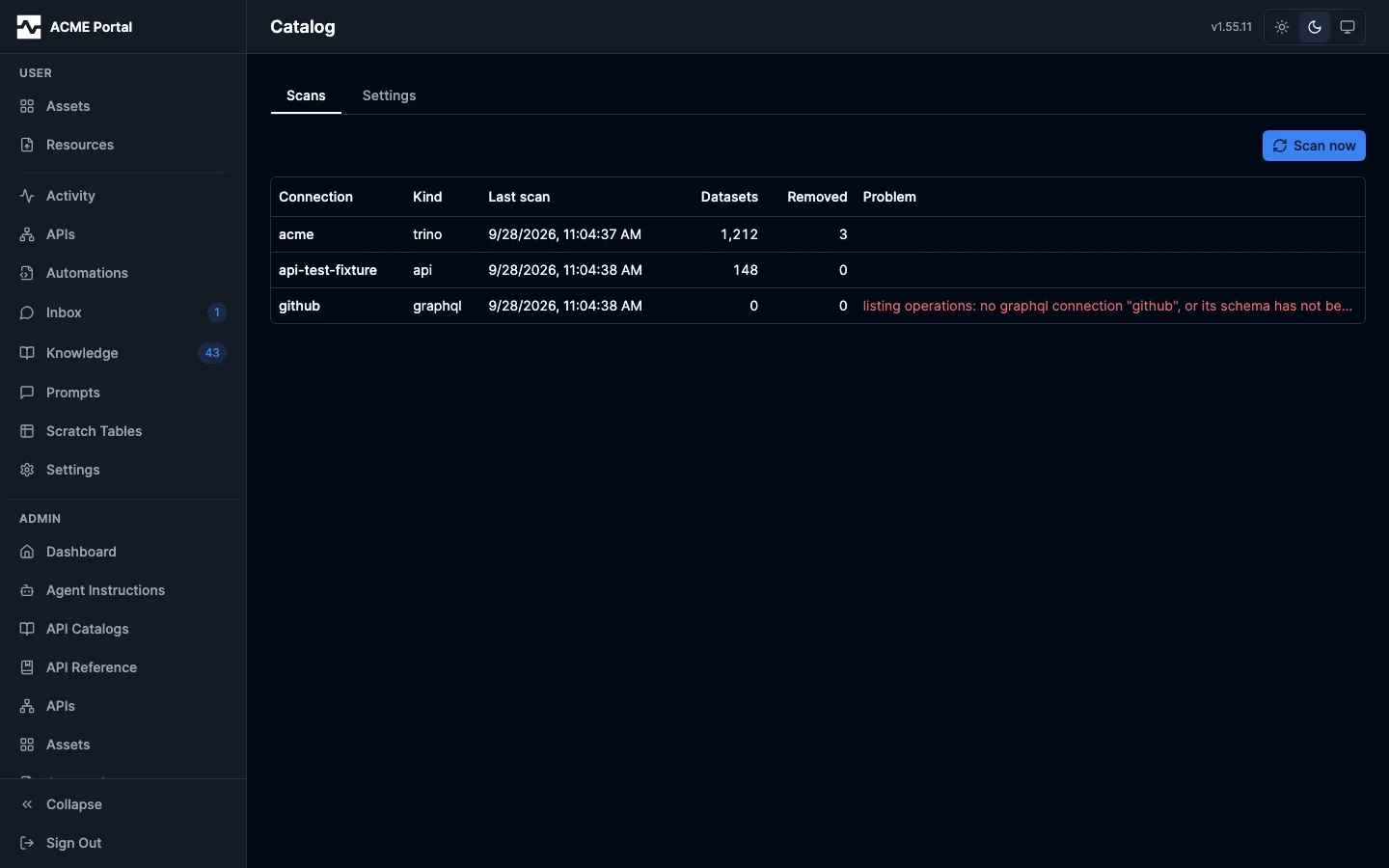
The Scans tab lists each connection's last scan: when it finished, how many
datasets it wrote, how many it marked removed, the problem when it failed, and
each part it could not read ("Not read: legacy", with the reason on hover). The
API reports those parts as unread, a list of {path, error} that is [] when
every part was read.
Scan now requests a scan of every connection without waiting for the
interval. The request is recorded, so whichever replica next takes the scan
lock runs it, even when another replica is scanning at that moment.
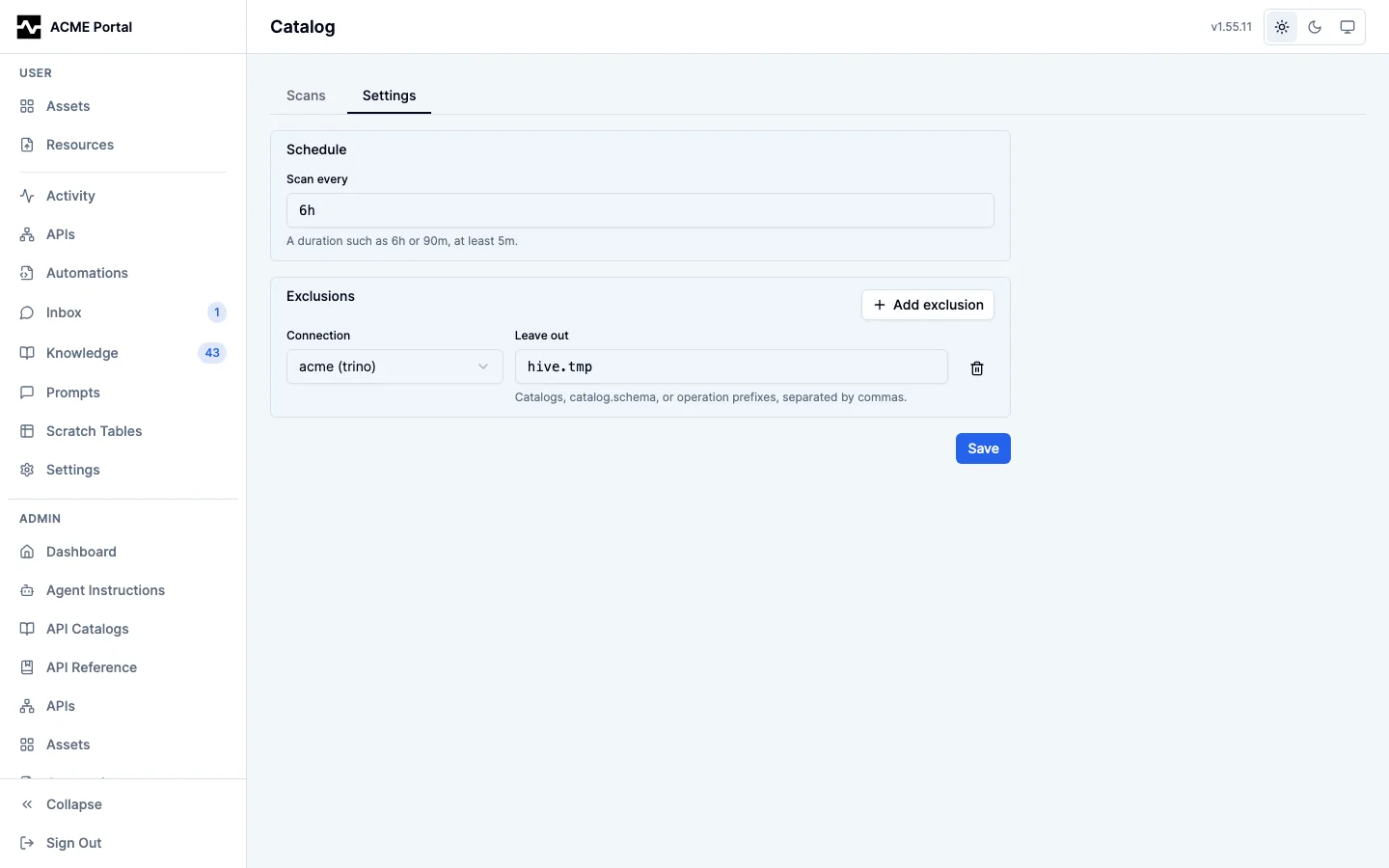
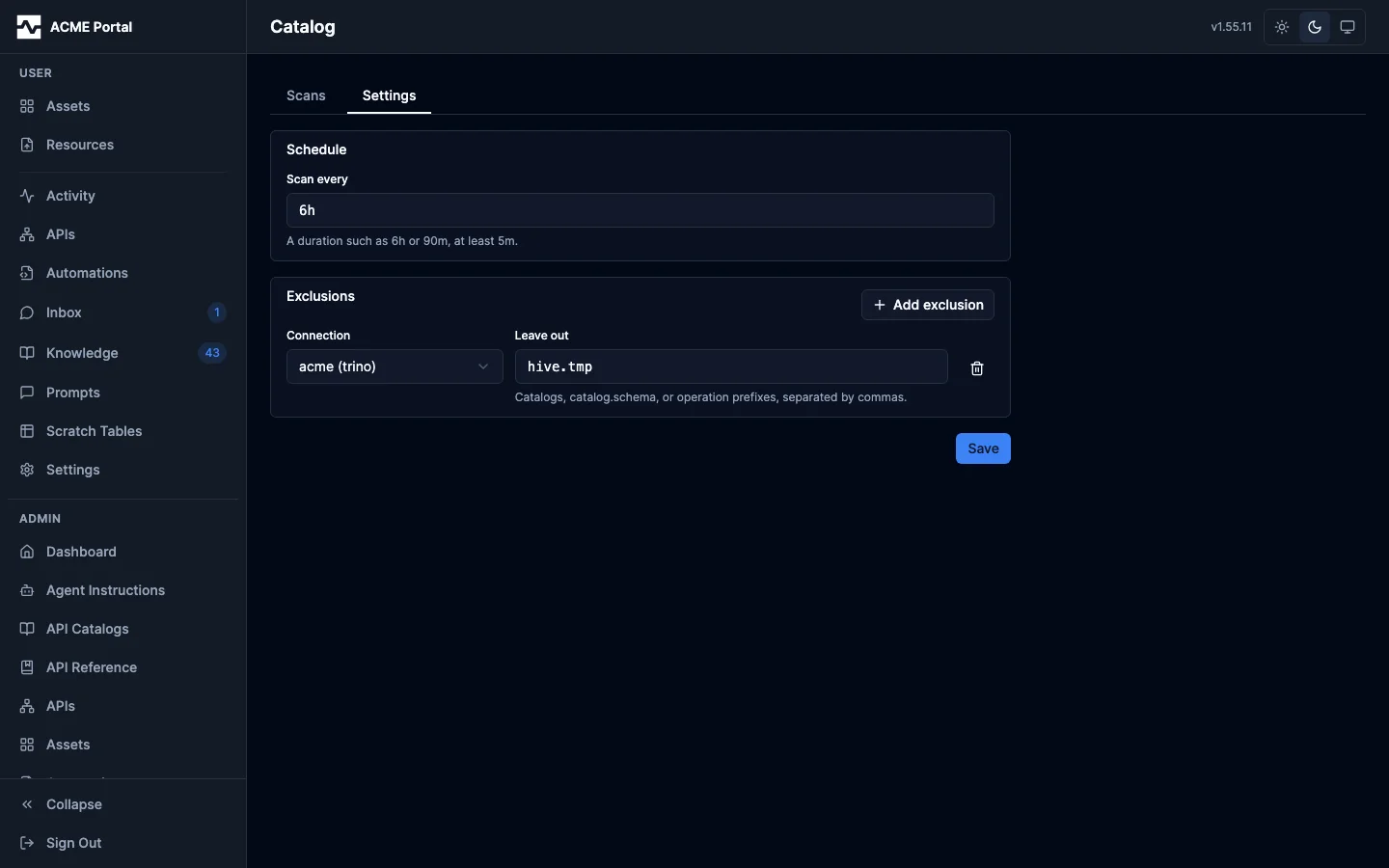
The Settings tab holds the two settings, stored in the database:
- Scan every: a duration such as
6hor90m, at least5m. - Exclusions: for a connection, the prefixes it leaves out of the catalog,
separated by commas. For Trino a prefix is a catalog (
hive), a schema (hive.tmp) or a table (hive.tmp.scratch); for GraphQL,mutationleaves out every mutation. The next scan leaves the excluded datasets out and marks any it cataloged before as removed.
The same settings and scans are served at /api/v1/admin/catalog/settings and
/api/v1/admin/catalog/scans, and the schema documents at
/api/v1/admin/catalog/documents; see the Admin API.
Search
search ranks catalog datasets through the platform's catalog-datasets
index, built from this catalog. A dataset declared or curated since the index
last read the catalog is re-read on the index queue's next check
(knowledge.index_reconcile_interval, five minutes by default), and the index
re-reads the whole catalog at least every knowledge.catalog_index.sync_interval.
Lineage
Lineage edges are recorded when the platform moves data:
- SQL: a statement run through
trino_executethat writes a table from what it reads (CREATE TABLE ... AS,INSERT INTO ... SELECT,MERGE INTO,CREATE VIEW ... AS) records an edge from each table it read to the table it wrote. An unqualified name resolves in the connection's default catalog and schema. The statement is read from the audited call, so a deployment withaudit.log_parameters: falserecords no SQL lineage. - Managed scripts: a run that succeeds records an edge from every table its queries read to every file it exported (a managed resource or a portal asset).
- Registrations: registering a table over a file records an edge from the
file (
mcp:resource:<id>ormcp:asset:<id>) to the table. A table registered over a script's export is therefore reached, walking upstream, from the tables the script read.
Each edge records what wrote it: the audited call, the script, or the registration. The semantic layer's lineage walk reads them.
Importing from DataHub
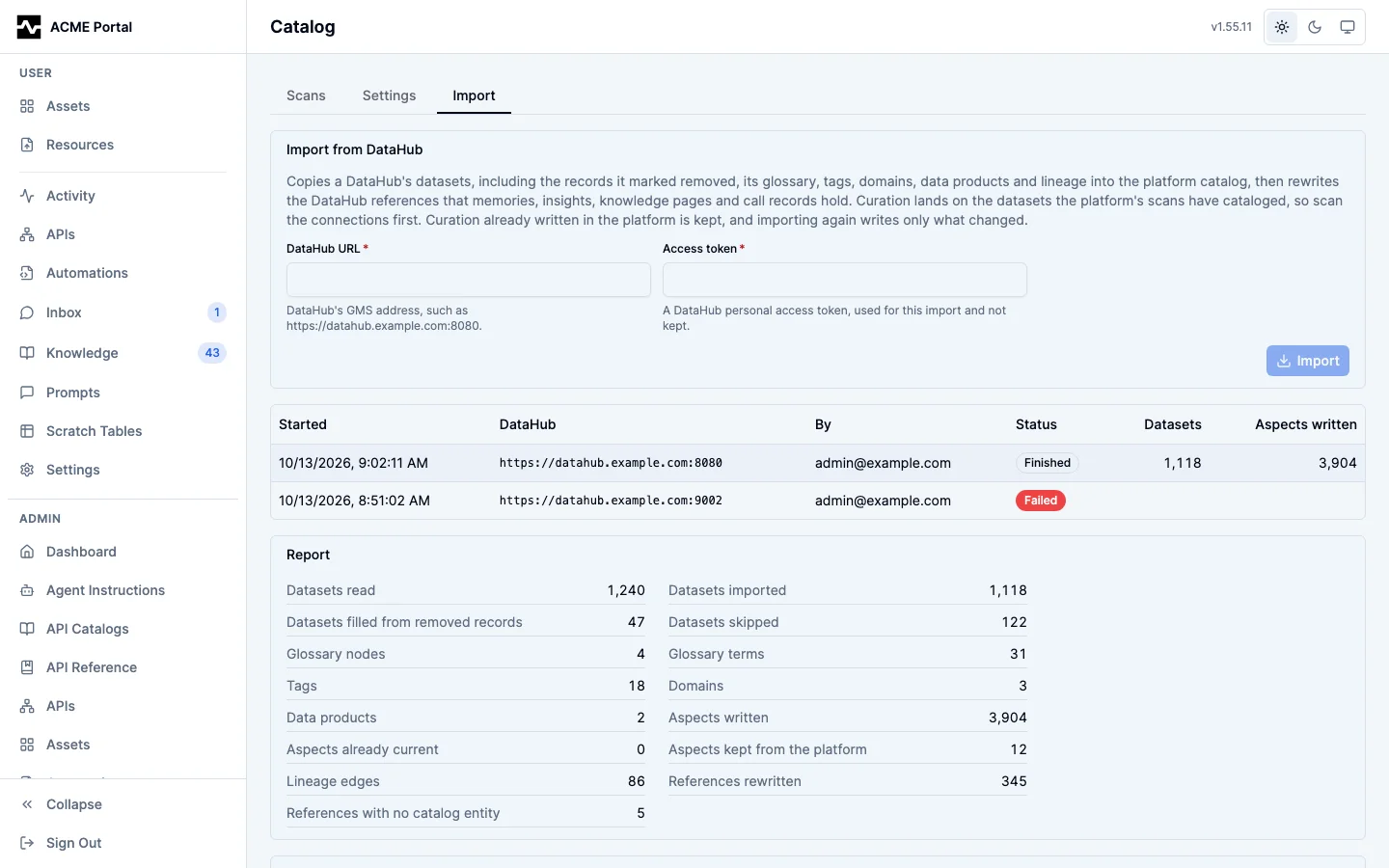
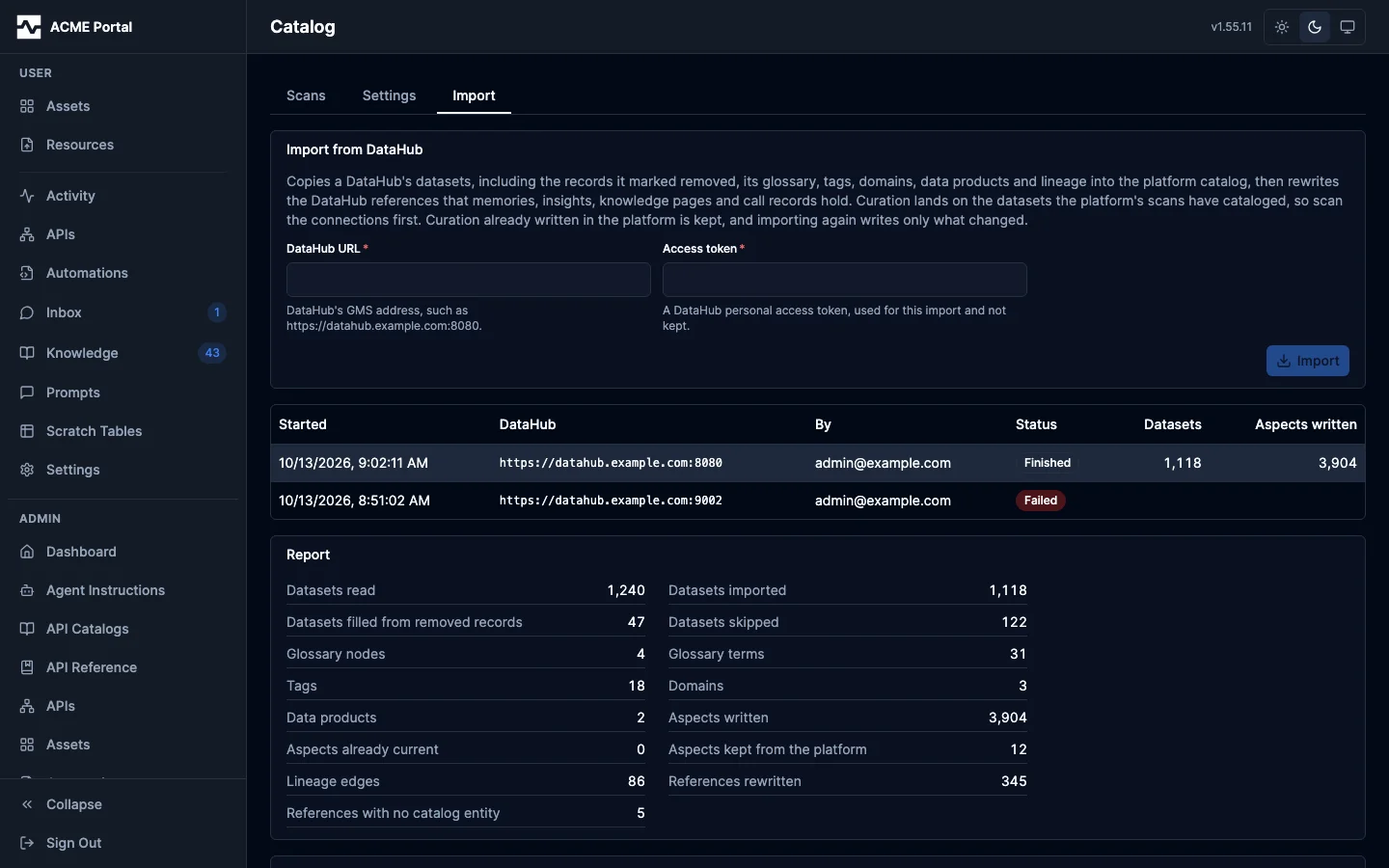
A deployment that kept its catalog in DataHub carries it into the platform
catalog once, from Admin > Catalog > Import or POST
/api/v1/admin/catalog/imports with DataHub's address and an access token (the
token is used for that run and not kept). Scan the connections first: a
dataset's curation lands on the catalog dataset with the same connection,
catalog, schema and table.
The import reads:
- every dataset DataHub holds, including the records it has marked removed. A live record's curation is taken; an aspect it lacks is taken from a removed record of the same path, so curation that exists only on a removed record is kept.
- the description (DataHub's edited one over its ingested one), tags, glossary terms, owners, domain, documentation links, custom and structured properties, curated queries, incidents and context documents of each dataset, and the description, tags and glossary terms of each top-level column.
- every glossary node, glossary term, tag, domain and data product, with its description, owners and documentation links. A term keeps the node it sits under.
- lineage between the datasets the catalog holds, recorded as the import's.
A dataset on a Trino platform is matched by its name, with a leading platform
instance dropped and semantic.urn_mapping.catalog_mapping read backwards;
semantic.urn_mapping.platform names the platform the deployment's datasets
were recorded under when it is not trino. Tableau entities, and datasets on
any other platform, are not imported.
An aspect something other than the import has written in the platform catalog is kept, and the report says so. Importing again writes only what changed in DataHub since, and keeps each definition under the key it was first stored under.
Then the import rewrites the DataHub URNs platform tables hold into catalog references: memories and insights (their entity references, column references and text), changesets, call records, knowledge pages (their body, summary and citations, which become catalog citations) and the rows of the dataset search index keyed by a DataHub URN, which the index reads again from the catalog. A URN the import has no catalog entity for (a user, a query entity, a dataset no connection catalogs) is left as it was and listed in the report with the table and row it was found in.
The report counts the definitions and datasets imported, the datasets that took curation from a removed record, the aspects written, left unchanged and kept, the lineage edges, and the references rewritten, and lists what was not carried over and why. One import runs at a time across replicas.
The semantic provider
With a database, the platform catalog is the semantic provider. The
semantic.provider setting accepts datahub, which is read as the platform
catalog until the setting is removed, and noop, which turns the semantic
layer off. semantic.instance, semantic.cache and semantic.urn_mapping
have no effect on the catalog: a dataset is keyed by its connection's own
catalog names, so no catalog mapping applies.