Do cross-references help LLM agents complete documents? Search cost, robustness, and unreachable content on a wiki-style corpus
A neutral evaluation report on what hyperlinks between the pages of an
organizational wiki contribute to a tool-using LLM agent, measured on
mcp-data-platform, an open-source MCP (Model Context Protocol) server that
exposes stored knowledge pages to agents through a search tool and a
fetch tool. The study series calls this the graph-completion study: the
agent's task is to complete operational documents whose required facts are
spread across the page graph. Every statistic below is recomputed from raw run data
committed under bench/results/graph-completion-confirmatory/ and
bench/results/graph-completion-probe/ by the script
bench/reports/graph-completion/graph_tables.py, and every figure by
figures.py beside it (both also run from the notebook
bench/reports/graph-completion/report.ipynb), offline, with no network
access and no API key; each claim cites the run directory it comes from.
This is the fourth report in the series; its siblings are the
knowledge-layer effectiveness report [1], the
knowledge-use report [2], and the
knowledge-pollution report [3].
Issue references (#1241, #1250, #1251, and so on) resolve in the platform
repository's tracker,
github.com/txn2/mcp-data-platform/issues,
which is where every pre-registration in the series is posted.
| Author | Craig Johnston (cj@imti.co), Deasil Works, Inc. / txn2 — ORCID 0009-0000-9041-4079 |
| Published | 2026-08-10 |
| Report version | 1.0 |
| DOI | 10.5281/zenodo.21881798 (version 1.0) |
| Subject under test | Whether explicit, authored cross-references between an organizational wiki's pages deliver something to an LLM agent that retrieval structurally cannot — facts search cannot rank, and a decidable notion of "done" — or something else: a cheaper and more robust route to content a searching-and-reading agent reaches anyway. One agent configuration throughout: an Anthropic Claude model (the opus alias) driven by the Claude Code CLI against the platform's MCP tools. |
| Platform builds | All 99 confirmatory episodes ran one commit-pinned build: 7e441e30 (the merge of the study design, #1268), with a -dirty suffix in every manifest because the run branch's own harness instruments were committed immediately after the runs (see Section 9). Corpora are a pure function of the generator spec (Seed 1250, EdgeDensity 3) and every manifest carries its corpus fingerprint; the reread tool refuses a fingerprint mismatch. No episode ran on a tagged release build. |
| Pre-registration | bench/docs/graph-completion-study-design.md (issue #1250); the confirmatory matrix ran under issue #1251 with the design's cells, certification horizons, elicitation string, kill conditions, and matrix frozen before any episode. This report is the condition-4 (boundary condition) outcome of that protocol's kill list, with its pre-registered instrument kill applied in writing. |
| How to cite | Section 10 |
Abstract
An LLM agent with two tools — keyword-plus-vector search over a wiki's
pages and fetch to read a page, including any links it carries — is asked
to write complete operational documents (a change plan, an incident
document, an onboarding document) whose required facts are spread across
many pages. We ask what the links between those pages deliver to that
agent, testing the two things hyperlinks might structurally provide that
retrieval cannot: routes to facts search cannot rank (a constraint whose
connection to the task is institutional rather than topical — this report
calls it semantic discontinuity), and a decidable notion of completeness (a
set of linked pages can be walked to its end; a ranked result list never
certifies coverage). The study is pre-registered, deterministic in its
corpus and grading, and run as a two-arm contrast in the trial sense: one
generated corpus planted twice, once with its authored cross-references as
real, followable links (the graph arm) and once with every link removed and
rewritten as an ordinary sentence carrying the same meaning (the stripped
arm), at 50, 500, and 5000 pages — page meaning held constant, only the
form of each connection, link or sentence, differing. The central result is the study's own pre-registered instrument
kill, and it is a finding about agent behavior, not a defect narrative:
constraints certified unreachable by two independent instruments — for every
task-derived phrasing, at both certified scales, before any episode ran —
were recovered by the stripped arm at 1.00 (500 pages) and 0.93 (5000
pages). The route is visible in every stripped transcript: the agent reads
the authored edge's meaning-preserving prose fallback on an ordinary page,
learns the named institution's vocabulary, and re-queries in that
vocabulary, which ranks the "unreachable" page instantly. The consequence
for any retrieval-benchmark design: "unreachable by search" must hold
against read-derived queries, and meaning-constant authored prose cannot
provide that, because prose that preserves meaning necessarily names what it
points at. What the matrix affirmatively shows is that discovery is not
enumeration — grounded coverage sat at ceiling in every cell, with roughly
eleven fetches grounding every constraint against a 5000-page store — and
that what authored edges buy is cost and robustness, not coverage: searches
per grounded constraint stayed flat for the graph arm across two orders of
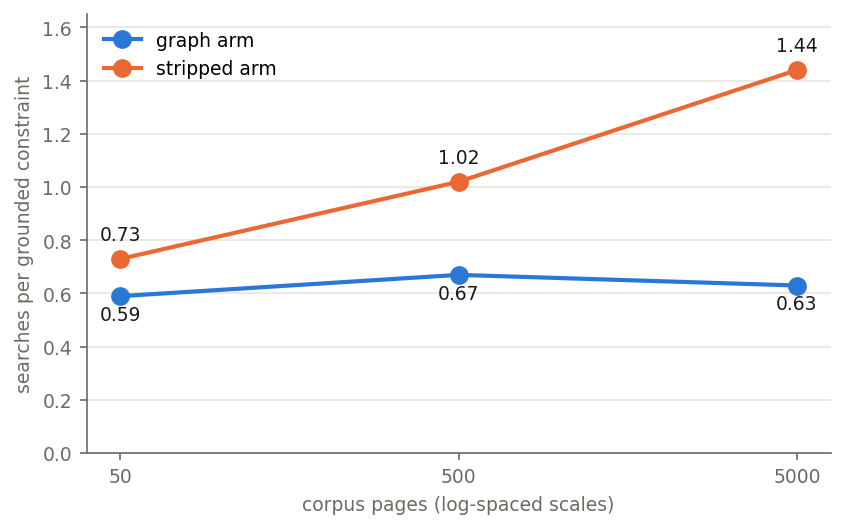
magnitude of corpus (0.59/0.67/0.63) while roughly doubling for the stripped
arm (0.73/1.02/1.44), the matrix's only failed episode and only sub-ceiling
cell sit in stripped/5000, and with search removed entirely the graph arm
walked every closure at full depth (1.00 grounded, zero searches) where the
pilot's stripped floors read 0.00. The elicited completeness claim was
uniformly conservative — 0 of 98 surviving episodes claimed completeness —
so whether edges change an agent's knowledge of its own done-ness is
unmeasured here, not null.
1. Relation to the pre-registered protocol
This report is the outcome of the stage-3 separation design in
bench/docs/graph-completion-study-design.md (issue #1250, epic #1254),
whose confirmatory matrix ran in full under issue #1251: 99 episodes as
pre-registered, no protocol amendment needed or made. The design followed
the register lifecycle — a premise probe first (#1241, archived under
bench/results/graph-completion-probe/), then a separation design with the
divergence mechanisms named before the fixture was built
(bench/docs/graph-completion-study-design.md, "The divergence mechanisms, named"),
then the frozen matrix. Standing of each part of the record, all declared:
- The pre-registered instrument kill fired, and its application governs
this report. The design pre-states that any stripped-arm discontinuity
grounding invalidates the certified-scale run pairs for the discontinuity
DV and that no kill condition is then read as a confirmatory finding
(
bench/docs/graph-completion-study-design.md, "Pre-stated kill conditions (confirmatory, #1251)"). That is what happened, and Section 3 reports it as the headline result about agent behavior and benchmark design. No coverage-delivery claim for authored edges survives it. - The cost and robustness readings stand. They are computed from the
same archives, do not depend on the discontinuity construct, and the
design names cost and provenance as dependent variables in their own right
(
bench/docs/graph-completion-study-design.md, "Dependent variables"). - The probe is the pilot. Its 72 episodes validated the instruments (plant verification, sweep gate, grounded-coverage grading, provenance) and supplied the no-search floors this report cites; none of its numbers are headline claims, and its 42-page corpus sits under the enumeration ceiling its own record names.
- The power audit's amendment rule did not trigger. The first certified
scale's coverage SD read 0.0000 against the 0.30 threshold
(
graph-confirmatory-driver.log), so k stayed at 5 per the frozen rule (bench/docs/graph-completion-study-design.md, "Estimator and power audit").
2. Apparatus
The platform under test is mcp-data-platform, an open-source MCP server
that exposes data and curated knowledge to LLM agents as tools — the same
stack the prior three reports used. Here it is configured with only its
knowledge-page surface: wiki-style pages are stored, chunk-embedded, and
reachable through the platform's search tool (lexical plus vector over
chunks) and read with fetch, whose response includes the page's authored
cross-references when they exist. No warehouse, catalog, or object store is
in the fixture. The agent is one fixed configuration throughout — an
Anthropic Claude model (opus alias) driven by the Claude Code CLI, one
fresh platform identity and session per episode (an episode is one agent
attempt at one task).
Corpus. A deterministic generated corpus
(bench/docs/graph-completion-study-design.md, "Corpus: deterministic generation at controlled scale"):
a fixed 27-page hand-authored core that is byte-identical at every scale,
inside generated operations-wiki filler at total scales of 50, 500, and 5000
pages (Seed 1250, EdgeDensity 3, frozen). Three completion tasks, called
cells — write a change plan, an incident-handling document, a
feed-onboarding document — each with an entry page handed to the agent in
the prompt and a nine-page closure (the set of pages reachable from the
entry page by following authored cross-references) that holds every graded
constraint: a fact the finished document must state, whose source is one
specific page. Each constraint is graded by its signature, a minted literal
(a class code, a unique digit run, a reserved word) that structurally
cannot occur outside its source page; all other prose is digit-free and
reserved-word-free, so a signature in a final document is evidence of
provenance, not coincidence.
The arm contrast. The graph arm plants the pages with their authored cross-references as real, resolvable edges (verified exact by the planter). The stripped arm plants the same pages with every reference rendered as its authored prose fallback — the page's meaning is preserved, the reference table is verified empty. The arms differ only in whether the connection is an edge or a sentence.
Semantic discontinuity, certified twice. Each cell carries two
constraints whose source pages are written in another department's
institutional register (a finance close calendar, a records schedule, an
attendance ledger, a compliance filing calendar, a commitment ledger, a
data-sharing register) and connected to the closure by one authored edge.
Before any episode, each scale was certified two ways
(bench/docs/graph-completion-study-design.md, "Twofold discontinuity certification"):
offline, every discontinuity page must rank outside the exclusion horizon
(top-25 at 500 pages, top-100 at 5000) by embedding similarity for every
task phrasing; live, the platform's own search swept three phrasings at
limits 5/25/100 per cell must never return a discontinuity page. Both
instruments passed at 500 and 5000; scale 50 is certifiably unsatisfiable by
construction and serves as the within-ceiling control. The certification
consumed one authored candidate before any episode — a duty rota that no
rewrite could separate from the incident task — which is the instrument
doing its job at authoring time. Certification records are archived per
scale under bench/results/graph-completion-separation/.
Matrix. Graph versus stripped, search on, k=5 per cell, 3 cells, at all
three scales (90 episodes), plus one auxiliary manipulation check —
graph with search disallowed at 5000 pages, k=3 per cell (9 episodes)
(bench/docs/graph-completion-study-design.md, "Arms and matrix (frozen for #1251)").
The agent is the fixed configuration stated above (client version 2.1.226
(Claude Code)), and every prompt carries the completeness elicitation
suffix. The design frames every
outcome by reading budget against corpus size and pre-rejects model-tier
framing; the corpus axis is what moves the ratio.
Dependent variables. Off-entry grounded coverage is primary — off-entry
meaning the constraints whose source pages are not the handed entry page,
so discovery is actually required; grounded meaning a constraint counts
only when its signature is in the final document AND a source page was
actually fetched. Coverage without a read is confabulation and is reported
separately (it is zero in every confirmatory cell).
Discontinuity grounded coverage is the same reading restricted to the
certified constraints. The elicited completeness claim is parsed from a
frozen "Open items" section into complete / gaps declared / no statement,
with overclaim defined as a completeness claim while a graded constraint is
absent. Cost is searches, fetches, and searches per grounded constraint;
provenance records, for every fetch, whether its reference was first seen in
a search result, on a fetched page, or nowhere
(bench/docs/graph-completion-study-design.md, "Dependent variables").
The confirmatory matrix, as measured (episode means; coverage grounded;
bench/results/graph-completion-confirmatory/):
| Scale | Arm | Search | n | fail | grounded | SD | disc grounded | searches per ep | fetches per ep | searches per grounded |
|---|---|---|---|---|---|---|---|---|---|---|
| 50 | graph | on | 15 | 0 | 1.00 | 0.00 | 1.00 | 5.3 | 15.3 | 0.59 |
| 50 | stripped | on | 15 | 0 | 1.00 | 0.00 | 1.00 | 6.5 | 16.1 | 0.73 |
| 500 | graph | on | 15 | 0 | 1.00 | 0.00 | 1.00 | 6.1 | 12.3 | 0.67 |
| 500 | stripped | on | 15 | 0 | 1.00 | 0.00 | 1.00 | 9.2 | 13.3 | 1.02 |
| 5000 | graph | off | 9 | 0 | 1.00 | 0.00 | 1.00 | 0.0 | 9.0 | 0.00 |
| 5000 | graph | on | 15 | 0 | 1.00 | 0.00 | 1.00 | 5.7 | 10.7 | 0.63 |
| 5000 | stripped | on | 14 | 1 | 0.95 | 0.19 | 0.93 | 12.2 | 11.2 | 1.44 |
At scale 50 the discontinuity DV is not read (within the enumeration
ceiling, by construction); its column there grades the same constraints as
ordinary spread constraints. The one failed episode is a client-side error
recorded and excluded from grading, with its transcript archived
(gs5000-opus-stripped-search-20260810-143259/).
3. Results: the certified-unreachable constraints were recovered — reading is a search route
The design's discontinuity construct rests on a premise stated in the
protocol: certification at a scale proves "no search route exists," so any
stripped-arm discontinuity grounding is an instrument leak that invalidates
the run pair
(bench/docs/graph-completion-study-design.md, "Pre-stated kill conditions (confirmatory, #1251)").
Stripped-arm episodes grounded the discontinuity constraints at both
certified scales:
- scale 500, stripped: discontinuity grounded coverage 1.00 — all 15
episodes, all six certified constraints
(
gs500-opus-stripped-search-20260810-123033/); - scale 5000, stripped: discontinuity grounded coverage 0.93 — 13 of the
14 surviving episodes
(
gs5000-opus-stripped-search-20260810-143259/).
This is not a harness leak. Both certifications passed both instruments before any episode; the sweep gates recorded zero discontinuity hits and zero signature leaks at the certified scales (each run archive embeds the gate reading it ran under); and no signature appears anywhere without its source page having been fetched. What the certifications proved is unreachability for task-derived queries — the cell prompt and its authored phrasings, which is exactly what both instruments sample. The defeating queries are read-derived. The stripped arm renders each authored edge as its meaning-preserving prose fallback ("work on systems that feed the statutory accounts also observes the company close calendar"); the agent finds an ordinary closure page through task-derived search, reads that sentence, and then queries the institution in the institution's own vocabulary — "company close calendar finance change freeze windows" (gs-change-plan replicate 1 at scale 500, the episode's third search) — which ranks the certified-unreachable page instantly. Fetch provenance in the stripped arms is 1.00 search at every scale: the agents ran the traversal in query space, two hops (read the mention, search its vocabulary) instead of one (follow the edge).
Per the frozen protocol text, the certified-scale run pairs are invalid for the discontinuity DV and no kill condition is read as a confirmatory finding. The scale-50 control behaved exactly as the design predicted (both arms 1.00, delta 0.00), so the instrument was clean; the construct was defeatable.
Two consequences, stated as this study's exportable results:
- For agent behavior: search-plus-reading closes vocabulary gaps that search alone cannot. An agent that re-queries with vocabulary learned from fetched pages performs, in query space, the traversal the graph arm performs over edges. This is the classical pseudo-relevance-feedback mechanism (Section 13) executed spontaneously by a reading agent, and it was strong enough here to defeat a twice-certified unreachability construct at both certified scales.
- For benchmark design: a claim that content is "unreachable by search" is a claim about a query distribution, and the distribution an agent actually samples includes queries derived from everything it has read. A meaning-constant stripped arm can never pose semantic discontinuity, because prose that preserves the page's meaning must name the institution, and naming the institution hands a reading agent the vocabulary that closes the embedding gap. Any future unreachability certification must hold against read-derived queries — which authored prose, by this argument, cannot provide.
4. Results: discovery is not enumeration
Off-entry grounded coverage sat at ceiling in every cell of the matrix: 1.00 everywhere except stripped/5000 at 0.95, whose deficit is one episode (gs-incident replicate 5: 3 of 10 constraints grounded; every other surviving episode in the cell is at 1.00). The pilot had left open a reading-budget-versus-corpus-size boundary — at 42 pages, an agent that can afford to read half the corpus hits ceiling with or without edges — and the natural expectation was that scale would eventually starve coverage. It did not, at any tested scale, for this configuration: at 5000 pages an episode makes roughly eleven fetches (10.7 graph, 11.2 stripped, per episode) — 0.2 percent of the corpus — and still grounds every constraint. Targeted search plus vocabulary learned from fetched pages collapses a 5000-page haystack as effectively as a 50-page one. Scale moved the cost (Section 5), not the coverage.
Two readings guard this claim. The scale-50 arms replicated the pilot's ceiling collapse exactly (both arms 1.00, delta 0.00), which is the design's own check that the haystack construction, not the scale axis, is what moved between scales. And confabulation — a signature in the document whose source page was never fetched — is zero in all 98 surviving episodes, so the ceiling is grounded coverage, not fluent guessing (the pilot measured a 19 percent confabulation rate in its unreachable slots, which is why grounding is the primary DV).
5. Results: authored edges buy search cost, and the gap grows with scale
The only separation anywhere in the matrix is cost. Searches per grounded constraint, graph versus stripped: 0.59 vs 0.73 at 50 pages, 0.67 vs 1.02 at 500, 0.63 vs 1.44 at 5000. The graph arm is flat across two orders of magnitude of corpus; the stripped arm roughly doubles. The matrix's only failed episode and its only sub-ceiling coverage cell also sit in stripped/5000 — at the largest scale, the queries-instead-of-edges strategy is not only costlier but is where the lone coverage wobble lives.
Provenance shows the mechanism. The share of graph-arm fetches whose reference was first seen on a fetched page — an edge actually used — rises with scale: 0.09 at 50 pages, 0.28 at 500, 0.34 at 5000. The stripped arm is 1.00 search-provenance at every scale, because it has no edges to use. Agents use the edges when they exist, and increasingly as the haystack grows; the edges just were not the only route to the content.
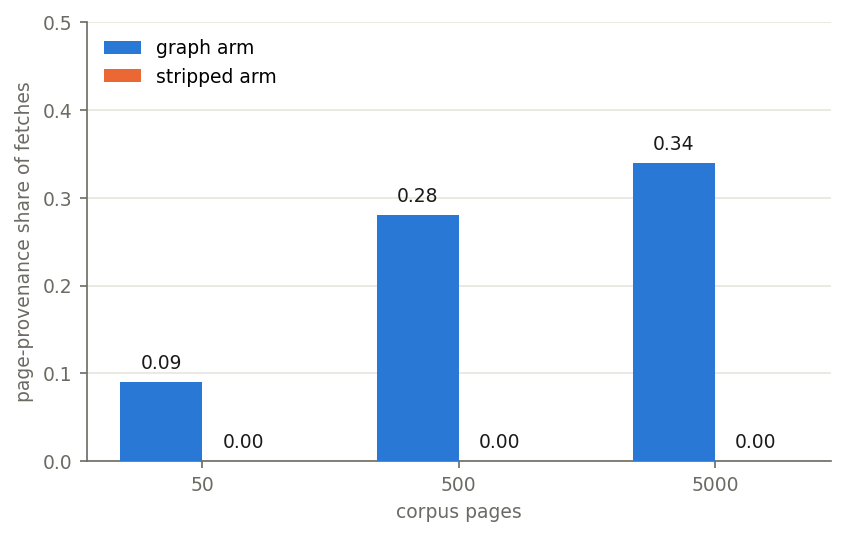
Stated as the study's second exportable result: at these scales, for an agent configuration that searches competently and re-searches with vocabulary it reads, authored edges do not change what a completion document contains; they change what producing it costs — and the saving grows with the corpus, because the stripped arm's re-derivation of each connection through query space is what scale taxes.
6. Results: edges are the only route when search is absent
The auxiliary manipulation check removed the search tool entirely: graph
arm, 5000 pages, k=3 per cell. All nine episodes walked their closure by
pure edge-following at full depth — 1.00 grounded coverage, 9.0 fetches per
episode (the closure size), zero searches. Voluntary traversal survives a
5000-page store around the closure, which makes the pilot's no-search
readings scale-invariant: at 42 pages the pilot's graph/no-search floors
were 0.96 (opus) and 0.42 (haiku), while its stripped/no-search floors were
0.00 at both reading budgets — with no edges and no search there is no
route at all, and the document simply lacks the content
(bench/results/graph-completion-probe/).
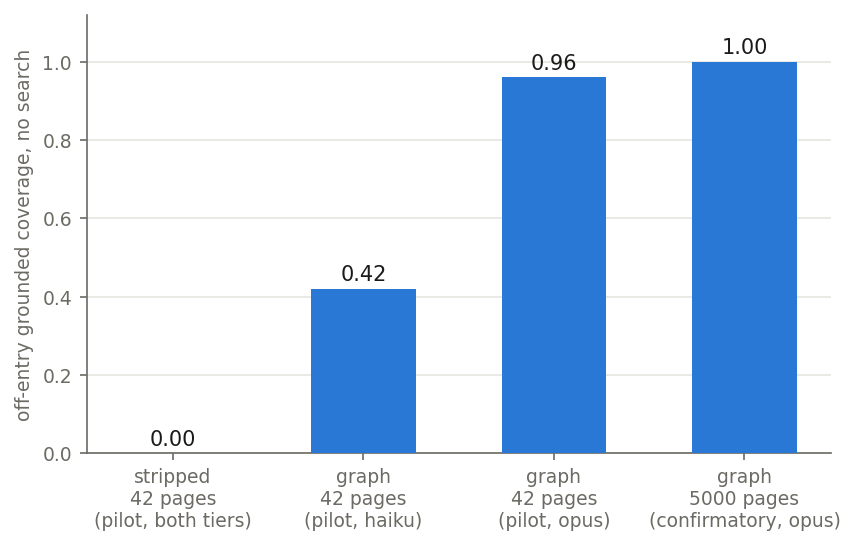
This is the robustness half of what edges buy: when search is degraded, disabled, or simply not competent — the pilot's weaker reading budget reached 0.29 grounded with edges against 0.10 without, at a third of the search cost per grounded constraint — the authored graph is the only discovery structure left, and agents demonstrably walk it unprompted.
7. Results: the completeness-claim channel is unmeasured, not null
Every prompt ended with the frozen elicitation: list open items, or write "None" if nothing is outstanding. Of 98 surviving episodes, 0 claimed completeness, 91 declared open items, and 7 omitted the section — at measured 1.00 grounded coverage, in both arms, at every scale. The overclaim rate is therefore 0.00 everywhere, and it would be wrong to read that as "edges do not change closure awareness": a channel in which no episode ever claims completeness cannot separate anything. The elicited claim is uniformly conservative for this agent configuration, so whether a walkable closure changes what an agent believes about its own done-ness is unmeasured at this configuration. The design's closure mechanism — a graph closure terminates, a ranked list never certifies coverage — remains plausible and untested; testing it needs an instrument that does not route through a self-report this configuration never makes.
8. Kill conditions, applied
Checked in the design's order
(bench/docs/graph-completion-study-design.md, "Pre-stated kill conditions (confirmatory, #1251)"):
| Kill condition | Reading |
|---|---|
| Instrument kills (checked before any condition is read) | Fired. Stripped-arm discontinuity grounding at both certified scales (1.00 at 500, 0.93 at 5000). The certified-scale run pairs are invalid for the discontinuity DV; no kill condition is read as a confirmatory finding. |
| Kill 1 — discontinuity mechanism (graph disc coverage below 0.25 everywhere) | Read informationally: would not fire. Graph-arm discontinuity coverage is 1.00 at every scale; agents follow the one authored edge to institutional content. |
| Kill 2 — closure mechanism (overclaim and off-entry deltas both under 0.10 everywhere) | Read informationally: numerically present (off-entry deltas +0.00 and +0.05; overclaim 0.00 both arms, both scales) — but the overclaim half is inert (Section 7), so this is a ceiling reading, not a mechanism null. |
| Condition 3 — proceed on a coverage or overclaim advantage | Read informationally: not met. The largest advantage anywhere is +0.07. |
| Condition 4 — anything else | The recorded outcome: a boundary condition, numbers to the register row, this report's claims argued from them. |
The completeness-delivery framing for authored edges is retired with the discontinuity construct — the arms did not differ in what documents contained at any scale. The framing that survives on evidence is cost (Section 5) and no-search robustness (Section 6).
9. Threats to validity
- One agent configuration. One model alias (
opus), one client (claude-cli2.1.226 (Claude Code)), one scaffold. The design pre-rejects tier framing and moves the reading-budget-to-corpus ratio through the corpus axis instead; the pilot's second configuration suggests the cost separation widens as the budget tightens (searches per grounded constraint 2.30 with edges vs 8.00 without, at 42 pages), but nothing at the study scales measures that (bench/docs/graph-completion-study-design.md, "Threats to validity"). - The discontinuity DV is invalid, by the study's own kill. Both certification instruments sample task-derived phrasings; the defeating queries are read-derived. The construct, not the harness, failed: the gates passed, the plants verified, the control replicated. Recorded as an instrument-defect row in the series register.
- Coverage contrasts have no headroom. With every cell at or near 1.00, the off-entry deltas (+0.00, +0.05) are ceiling readings; this report claims cost separation, not coverage separation, for exactly that reason.
- The cost reading is configuration-bound. Searches per grounded constraint is a behavioral quantity of one client and one model configuration; the flat-versus-doubling shape is the claim, not the absolute values.
- Generated filler monoculture. Filler clusters share template families; an embedding model could rank them degenerately, making the haystack easier or harder than a real wiki. Both certification instruments measure the outcome that matters per scale, and the readings are archived per scale rather than assumed from one, but the residual risk stands.
- Digit-free filler and memorable mints. Signature-by-construction requires filler prose to spell out quantities, a mild register shift; and minted class codes may be easier to carry into a document than prose facts, inflating absolute coverage. Both are identical across arms; contrasts are unbiased.
- The elicited claim channel biases against overclaim — declaring a gap costs one line — and in the event it was fully inert (Section 7). Its 0.00 rates bound nothing about closure awareness.
- Build provenance. Every manifest records commit
7e441e30…-dirty: the platform code is the #1268 merge, and the dirty suffix is the run branch's own harness instruments, committed immediately after the runs — the provenance guard reporting honestly. Corpora are spec-generated and fingerprint-verified, so the fixture is exactly reproducible regardless. - One failed episode. The stripped/5000 run recorded one client-side error: the client's result event carried its error flag with subtype "success" (archived as "episode: claude reported success"; the transcript ends in a mid-response server error). It is archived with its transcript, counted as a failure, and excluded from grading.
- Paraphrase undercount. Signature grading is a lower bound on coverage, identical in both arms.
- Reading the archives. The per-scale
graph-study-gate-*.jsonandgraph-study-plant-*.jsonfiles at the archive root are the last arm's at each scale (the driver overwrites them per arm); every run archive embeds the gate reading and plant record it actually ran under, and that is what the analyzer, the reread tool, and this report's toolchain consume.
10. How to cite this report
Johnston, C. (2026). Do cross-references help LLM agents complete documents? Search cost, robustness, and unreachable content on a wiki-style corpus (version 1.0). mcp-data-platform benchmark report series. DOI: 10.5281/zenodo.21881798.
BibTeX.
@techreport{johnston2026graphcompletion,
  author      = {Johnston, Craig},
  title       = {Do Cross-References Help {LLM} Agents Complete Documents?
                 Search Cost, Robustness, and Unreachable Content on a
                 Wiki-Style Corpus},
  institution = {Deasil Works, Inc. / txn2},
  year        = {2026},
  month       = {8},
  type        = {Benchmark report},
  doi         = {10.5281/zenodo.21881798},
  url         = {https://mcp-data-platform.txn2.com/reference/benchmark-report-graph-completion/}
}
The repository-level CITATION.cff and .zenodo.json continue to carry the
series' first deposit; each report's own DOI lives on its page and in its
Zenodo record.
11. Data availability
This study's three run families sit at the top level of bench/results/
(recorded as a naming exception in bench/README.md, beside the
knowledge-layer study's):
| Run family | Directory under bench/results/ |
Contents |
|---|---|---|
| Premise probe (pilot) | graph-completion-probe/ |
72 episodes over the 42-page corpus: 2x2 of arm and search condition, two reading budgets, k=3, with design doc, per-arm plant and sweep-gate records, offline analyzer, and driver log |
| Separation validation | graph-completion-separation/ |
No episodes: the per-scale certification record — offline embedding certification, live sweep gate, and plant records at 50/500/5000 — archived before the matrix was proposed |
| Confirmatory matrix | graph-completion-confirmatory/ |
99 episodes (98 graded, 1 recorded failure) across seven runs, with per-run manifests, embedded gate and plant records, full transcripts, per-scale certification records, the offline analyzer and its archived output, and the study summary with the kill application |
Every run archives its manifest (commit, platform version, model, client
version, disallowed tools, k, generator spec, corpus fingerprint), per-attempt
readings, coverage gradings, final documents, and full transcripts. Every
table above regenerates via
python3 bench/reports/graph-completion/graph_tables.py from these
directories, offline, and every figure via figures.py beside it (both also
run from report.ipynb). The recompute is a build gate, not just a
convenience: make bench-report-check (part of make verify and of CI's
harness job) re-derives the headline numbers from the archives — including
the instrument kill's presence and the archived analyzer's deliberate
non-zero exit — and fails on any drift from the values this page prints.
graphstudy -mode reread re-derives any single run's readings from its raw
transcripts, regenerating the exact corpus from the manifest's spec and
refusing on fingerprint mismatch.
12. Synthesis and design consequences
Read with its three siblings, the series has measured what a knowledge layer delivers [1], when agents use it [2], what an admitted error costs [3], and now what the structure between pages is for. The answer is narrower and more durable than the completeness story the study went in with: for a capable, reading agent, authored edges are an efficiency and resilience feature, not a reach feature. Search plus reading reaches everything the graph reaches — at these scales, against this corpus construction — because reading is itself a search route; what the graph changes is the price of each connection (flat versus doubling with scale) and what happens when search is not there to pay it (a full-depth walk versus a 0.00 floor).
For the platform's curation guidance, the evidence supports writing cross-references for economy and resilience rather than reach: an authored edge saves the reader a re-derivation through query space that grows with corpus size, and it is the only route that still works when search is degraded or absent. The graph view and reference scanning earn their keep on those grounds without any claim that un-linked content is unreachable — this study measured the opposite for its strongest attempt at unreachable content.
For benchmark design, the exportable lesson is the kill: unreachability certifications sample a query distribution, and an agent that reads before it re-queries samples a different one. Certifying against task-derived phrasings — which is what both of this study's instruments did, and what embedding-rank exclusion arguments generally do — certifies against the wrong distribution. A future discontinuity instrument must either hold against read-derived queries (which meaning-constant prose cannot, since preserving meaning preserves the vocabulary trail) or vary what documents say across arms and accept grading two different corpora, the confound this design refused by construction. The register records this as the series' instrument rule: "unreachable by search" must survive an agent that has already read the mention.
13. Related work
The mechanism behind the instrument kill is classical information retrieval. The vocabulary problem — that two people name the same thing alike with probability under 0.20, so any single phrasing samples term space thinly — is Furnas et al. [4], and query expansion from read documents is pseudo-relevance feedback, surveyed by Carpineto and Romano [5]; BEIR [6] documents the lexical gap's persistence in modern retrieval stacks. What this study adds to that line is the observation that a completion-task agent performs the PRF loop spontaneously — read a mention, re-query in its vocabulary — and that the loop is strong enough to defeat a twice-certified unreachability construct. The agentic-retrieval literature documents the loop's power on open benchmarks: Self-Ask [7] and IRCoT [8] derive each next query from what was just read, and Search-o1 [9] triggers retrieval at self-detected knowledge gaps; none of them, to our reading, state the benchmark-design consequence this study's kill forces. That consequence has a parallel lineage in adversarial benchmark construction, where "unsolvable by the filter" certifications are repeatedly defeated by later systems — SWAG's filter by BERT, prompting HellaSwag [10]; AFLite formalizing the relativity of such filters [11] — and this study's version is sharper only in that the defeating distribution (read-derived queries) was generated by the evaluated agent inside the evaluated episode.
On what graphs buy: graph-augmented retrieval systems increasingly compete on cost rather than accuracy — HippoRAG [12] claims parity with iterative retrieval at an order of magnitude lower cost, LightRAG [13] pitches graph-indexed retrieval as the cheap alternative to GraphRAG's [14] community summarization, and GraphRAG-Bench [15] reports that graph variants frequently fail to beat vanilla retrieval on accuracy. Those comparisons vary the system over a fixed corpus; this study varies the corpus's edge explicitness under one system, holds page meaning constant, and reads cost against a two-orders-of-magnitude scale axis — which is, to our knowledge, the first controlled graph-versus-prose corpus pair with a flat-versus-scaling cost result. The traversal side descends from multi-hop reading comprehension (WikiHop [16], HotpotQA [17]) and link-conditioned retrieval (Asai et al. [18], which found hyperlink-following beats pure search exactly where lexical overlap is weak); the completeness side's negative result — that eliciting "are you done?" cannot measure closure awareness in an agent that never claims done-ness — is what the technology-assisted-review literature would predict, having long replaced searcher self-report with external statistical stopping criteria [19].
14. References
- Johnston, C. (2026). Does a semantic knowledge layer make an agent measurably better? A reproducible benchmark. mcp-data-platform benchmark report series, v2.0. DOI: 10.5281/zenodo.21438044. The series' harness lineage; its knowledge-page sink is the surface this study's corpus is planted through.
- Johnston, C. (2026). When do agents use stored knowledge? Derivability, capability, and the limits of a knowledge layer (version 1.0). mcp-data-platform benchmark report series. DOI: 10.5281/zenodo.21614059. Source of the budget-versus-capability framing this study's design inherited.
- Johnston, C. (2026). Knowledge pollution: Verification displacement, capability, and the price of a curation gate (version 1.0). mcp-data-platform benchmark report series. DOI: 10.5281/zenodo.21834813. Sibling study; its recompute-and-pin toolchain convention is reused here.
- Furnas, G. W., Landauer, T. K., Gomez, L. M., Dumais, S. T. (1987). The vocabulary problem in human-system communication. Communications of the ACM 30(11).
- Carpineto, C., Romano, G. (2012). A survey of automatic query expansion in information retrieval. ACM Computing Surveys 44(1).
- BEIR: heterogeneous zero-shot retrieval benchmark. arXiv:2104.08663.
- Self-Ask: measuring and narrowing the compositionality gap. arXiv:2210.03350.
- IRCoT: interleaving retrieval with chain-of-thought reasoning. arXiv:2212.10509.
- Search-o1: agentic search-enhanced large reasoning models. arXiv:2501.05366.
- HellaSwag: can a machine really finish your sentence? arXiv:1905.07830.
- AFLite: adversarial filters of dataset biases. arXiv:2002.04108.
- HippoRAG: neurobiologically inspired long-term memory for LLMs. arXiv:2405.14831.
- LightRAG: simple and fast retrieval-augmented generation. arXiv:2410.05779.
- GraphRAG: from local to global, a graph RAG approach to query-focused summarization. arXiv:2404.16130.
- When to use graphs in RAG: a comprehensive analysis for graph retrieval-augmented generation. arXiv:2506.05690.
- WikiHop: constructing datasets for multi-hop reading comprehension across documents. arXiv:1710.06481.
- HotpotQA: a dataset for diverse, explainable multi-hop question answering. arXiv:1809.09600.
- Asai, A., et al. (2020). Learning to retrieve reasoning paths over Wikipedia graph for question answering. arXiv:1911.10470.
- Stopping methods for technology-assisted reviews based on point processes. arXiv:2311.08597.