Observability (Prometheus metrics and distributed tracing)
mcp-data-platform exposes operational metrics in Prometheus format on a dedicated HTTP listener, plus optional OpenTelemetry distributed tracing. Two chokepoints cover every tool call through the platform:
MCPToolCallMiddlewarerecords request rate, latency, and outcome for every tool the platform serves (Trino, DataHub, S3, MCP gateway, REST shim, admin tools/call). One series per (tool, toolkit_kind, persona, status_category).- apigateway transport records outbound HTTP rate and latency for
every call made by the
apitoolkit —api_invoke_endpoint,api_export, and the REST gateway shim. One series per (connection, http_status_class, status_category, persona).
Beyond those chokepoints, toolkit and provider call paths are also
instrumented (Trino, DataHub, S3, OAuth token issuance/refresh, and
database/sql pool saturation — see Exposed metrics
below), and each tool call can additionally be traced end-to-end — see
Distributed tracing.
Configuration
Metrics are enabled by default. Configuration is environment-only for Phase 1.
| Variable | Default | Purpose |
|---|---|---|
OTEL_METRICS_ENABLED |
true |
Master switch. Set to false (or 0) to skip MeterProvider construction and not start the listener. |
OTEL_METRICS_ADDR |
:9090 |
Bind address for the /metrics HTTP listener. |
The listener is intentionally separate from the platform's main MCP/HTTP listener so:
- scrape traffic does not share the MCP/admin/portal auth path,
- the metrics port can sit behind a Kubernetes
NetworkPolicy(or be unreachable from outside the cluster) without affecting client-facing routes, - a slow or stuck scraper cannot starve the main accept loop.
To disable on a specific instance:
Kubernetes scrape config
Add a ServiceMonitor (Prometheus Operator) or a static scrape job:
apiVersion: monitoring.coreos.com/v1
kind: ServiceMonitor
metadata:
  name: mcp-data-platform-metrics
spec:
  selector:
    matchLabels:
      app: mcp-data-platform
  endpoints:
    - port: metrics
      path: /metrics
      interval: 30s
Expose port 9090 from the pod and surface it as a metrics service port.
Plain Kubernetes manifests (no Helm, no Operator CRDs) ship in
deployments/observability/:
pod-annotations.yaml (enable the listener plus prometheus.io/* scrape
annotations), recording-rules.yaml and alert-rules.yaml (ConfigMaps
with starter rules in the level:metric:operations convention, e.g.
mcp:tool_call_duration:p95_5m and apigateway:inbound_error_rate:5m),
and a README covering how to load them and confirm scraping with
up{job="mcp-data-platform"}.
Exposed metrics
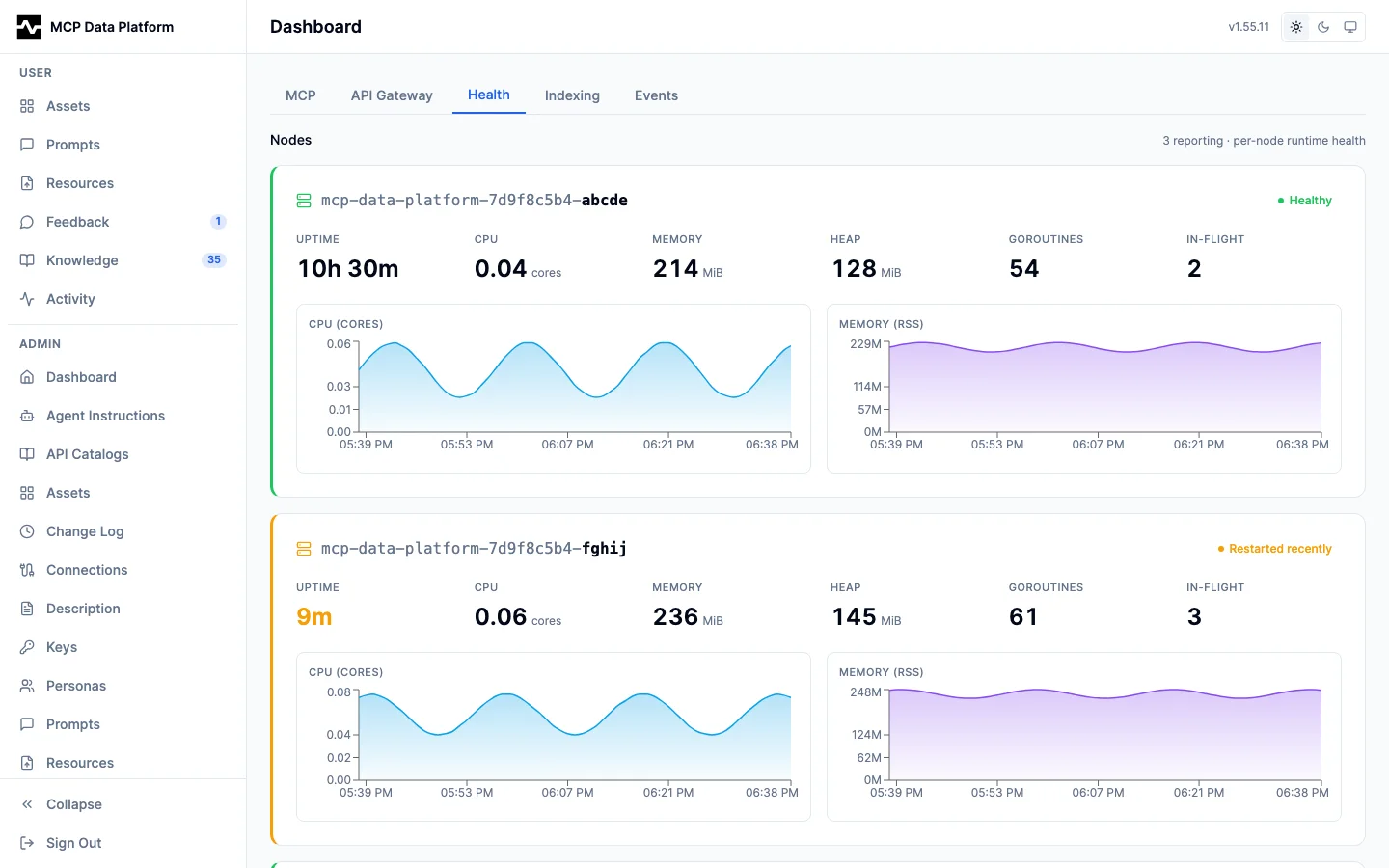
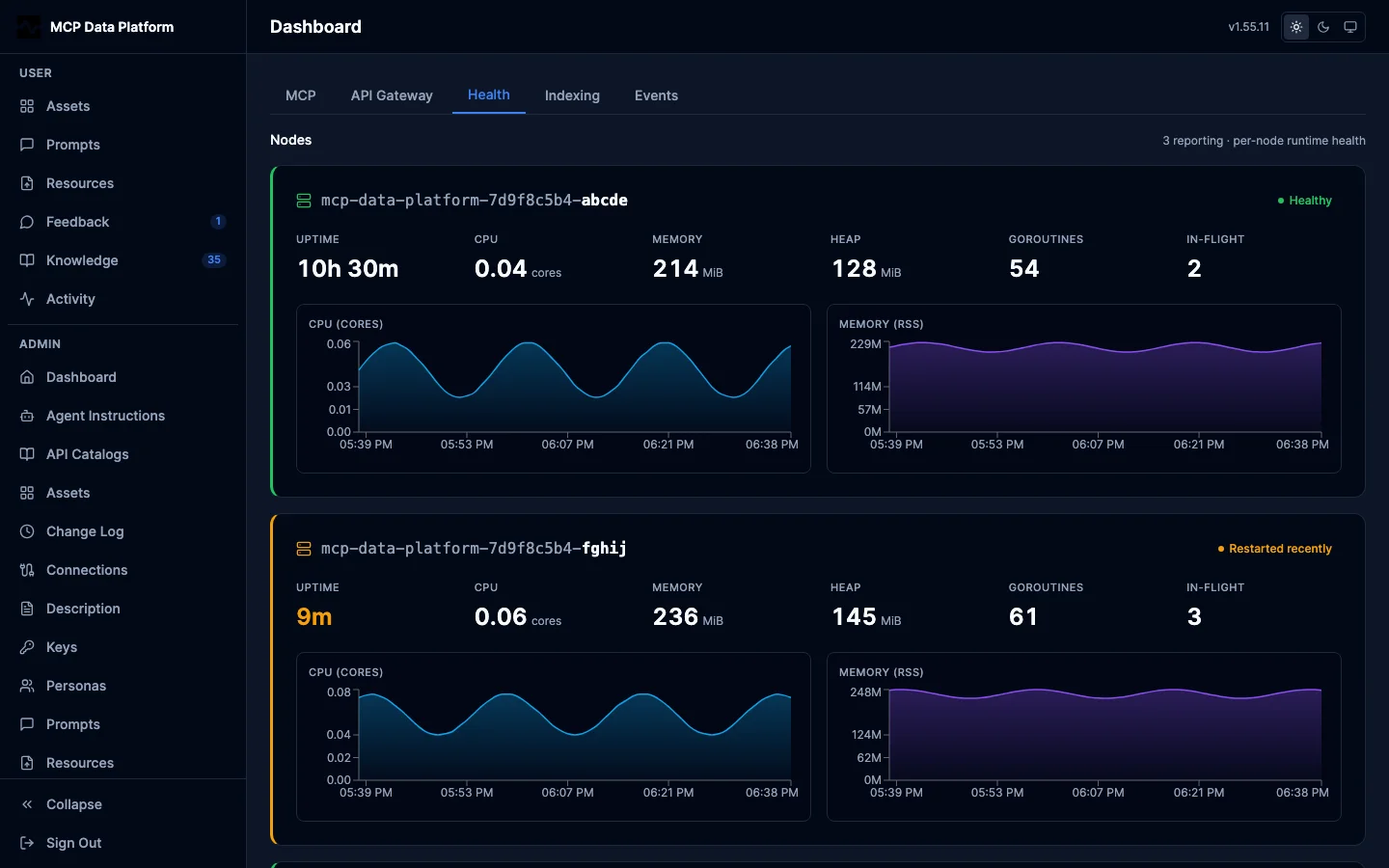
The portal reads a subset of these back per node under Admin > Dashboard > Health: uptime, CPU, resident memory, heap, goroutine count and in-flight calls, with per-node CPU and memory trend charts beneath them and any metric the scrape did not return rendered as a dash. Prometheus remains the place to query them; the tab is the at-a-glance read.
| Name | Type | Labels |
|---|---|---|
mcp_tool_calls_total |
counter | tool, toolkit_kind, persona, status_category |
mcp_tool_call_duration_seconds |
histogram | tool, toolkit_kind, persona, status_category |
mcp_inflight_tool_calls |
gauge | (none) |
mcp_enrichment_bytes_total |
counter | tool, toolkit_kind, persona |
apigateway_outbound_total |
counter | connection, http_status_class, status_category, persona |
apigateway_outbound_duration_seconds |
histogram | connection, http_status_class, status_category |
apigateway_inbound_requests_total |
counter | connection, operation_id, method, status_class, identity |
apigateway_inbound_duration_seconds |
histogram | connection, operation_id, method, status_class |
trino_queries_total |
counter | status, query_kind |
trino_query_duration_seconds |
histogram | query_kind |
datahub_requests_total |
counter | operation, status |
datahub_request_duration_seconds |
histogram | operation |
s3_operations_total |
counter | operation (s3_list.buckets, s3_list.objects, s3_object.<action>), status |
s3_operation_duration_seconds |
histogram | operation |
script_runs_total |
counter | script, trigger, status |
script_run_duration_seconds |
histogram | script |
script_runs_running |
gauge | (none) |
script_missed_fires_total |
counter | script |
script_run_admission_refusals_total |
counter | reason (ceiling, memory, cpu) |
script_run_queue_wait_seconds |
histogram | (none) |
indexjob_enqueued_total |
counter | kind, trigger, result |
indexjob_jobs_total |
counter | kind, trigger, outcome |
indexjob_duration_seconds |
histogram | kind, outcome |
indexjob_running |
gauge | kind |
indexjob_items_total |
counter | kind, result |
indexjob_embed_calls_total |
counter | kind, status |
indexjob_embed_texts_total |
counter | kind |
indexjob_embed_call_duration_seconds |
histogram | kind |
indexjob_leases_released_total |
counter | (none) |
indexjob_units_deferred_total |
counter | kind |
indexjob_queue_jobs |
gauge | kind, state |
indexjob_failed_units |
gauge | kind |
indexjob_oldest_runnable_wait_seconds |
gauge | kind |
indexjob_vectors_indexed |
gauge | kind |
indexjob_vectors_expected |
gauge | kind |
oauth_token_issuance_total |
counter | grant_type, status |
oauth_token_refresh_total |
counter | status |
oauth_token_refresh_duration_seconds |
histogram | (none) |
audit_events_dropped_total |
counter | (none) |
db_pool_open_connections |
gauge | pool |
db_pool_in_use |
gauge | pool |
db_pool_idle |
gauge | pool |
db_pool_wait_count_total |
counter | pool |
db_pool_wait_duration_seconds_total |
counter | pool |
Plus the free Go runtime + process metrics (go_*, process_*).
Trino rows are recorded for the queries and catalog/metadata calls the
query provider makes (cross-enrichment); user-facing trino_query tool
calls are also counted by mcp_tool_calls_total{toolkit_kind="trino"}.
query_kind is the SQL verb (select, show, insert, ...) for SQL
queries, or the metadata operation (list_catalogs, list_schemas,
list_tables, describe_table) for catalog calls; unknown SQL maps to
other. A trino_bytes_scanned_total metric was considered but is not
implemented: the mcp-trino client (v1.3.0) does not expose a
bytes-scanned figure in its query stats, so there is no honest source
for it.
Managed scripts are measured where a run reaches a terminal state, not
where it is enqueued, so the counter is of executions rather than intentions
and the histogram carries what the run actually took. script is the script's
name — bounded by what people wrote and reviewed — and trigger separates a
scheduled fire from a run_script call. script_runs_running is bracketed
around the execution rather than incremented at the end: a run that never
finishes never records a terminal observation, and a worker wedged on one is
what the gauge exists to show. script_missed_fires_total counts the fires the
misfire policy stepped over, which is the one thing the run table cannot show,
because a missed fire is precisely a run that does not exist.
script_run_admission_refusals_total counts the times a replica's worker
declined to claim another run while the queue held work, by the reason its
admission gave (#1843): ceiling is the configured maximum binding, memory
and cpu are the replica out of headroom. script_run_queue_wait_seconds is
how long a run waited between becoming due and being claimed; together they
tell capacity from load as what holds work back:
# automations that are failing
sum by (script) (increase(script_runs_total{status="failed"}[24h]))

# automations that are not keeping their cadence
sum by (script) (increase(script_missed_fires_total[24h]))

# the slowest 5% of runs
histogram_quantile(0.95, sum by (le) (rate(script_run_duration_seconds_bucket[24h])))
The portal's admin Automations page reads these on its Runs tab, beside the run rows themselves; see Admin portal.
Enrichment overhead: mcp_enrichment_bytes_total accumulates the byte
size of the cross-enrichment content (semantic context, memories, knowledge
pages, discovery notes) appended to each tool response. It is recorded only on
enriched successes, so divide by the matching mcp_tool_calls_total to get the
average per-call overhead an agent's context window pays:
rate(mcp_enrichment_bytes_total[5m]) / rate(mcp_tool_calls_total[5m]). Use it
to size the memory-enrichment budget (enrichment.memory_context_budget_bytes).
DataHub operation is one of get_entity, get_schema,
get_schemas, get_lineage, get_column_lineage, get_glossary_term,
get_queries, search_across_entities, semantic_search,
search_documents, get_related_documents, get_document.
S3 operation is the S3 tool name (list_buckets, list_objects,
get_object, get_object_metadata, presign_url, ...).
Audit drops: audit_events_dropped_total counts audit events lost by the
async audit writer: queue-full drops plus writes that failed or were abandoned
at the per-write timeout. Audit writes run through a single background goroutine
with a per-write timeout, so a stalled database sheds audit load instead of
blocking tool calls or leaking goroutines; a growing counter means the store
cannot keep up and rows are being lost by design (audit delivery is
best-effort). Alert on rate(audit_events_dropped_total[5m]) > 0.
Database connection pools are reported at scrape time from each
managed *sql.DB's Stats(). The platform shares one pool, registered
under pool="platform".
The apigateway_inbound_* pair measures requests hitting the REST shim
(POST /api/v1/gateway/{connection}/invoke, the NiFi-class ETL path),
as opposed to apigateway_outbound_*, which measures the platform's own
calls to the upstream API. operation_id is the OpenAPI operationId
resolved from the connection's catalog by path-template matching (e.g.
GET /v1/users/123 resolves to getUser); it is unknown for
connections with no catalog or requests that match no spec path.
identity is the API key name or OIDC subject (unknown when
unauthenticated) and is recorded on the request counter only, never on
the duration histogram, to keep the histogram's bucket series from
multiplying by the identity dimension. The connection and method
labels are clamped to the registered-connection set and the supported
HTTP-method set respectively, so an arbitrary URL segment or request
body cannot mint unbounded label values (both fall back to unknown).
apigateway_outbound_total carries persona: the persona the call was
authorized under, which is what separates an automated principal's
traffic from an analyst's on a connection they share. Both the MCP tool
path (api_invoke_endpoint, api_export) and the REST shim record it,
since the shim re-enters through the same tool call. It is bounded by the
deployment's persona definitions rather than by its user count -- an OIDC
subject is deliberately not a label here -- and a call the platform could
not attribute records unknown, the same value mcp_tool_calls_total
records for a call that never reached persona resolution, so the two
metrics name a principal identically. persona is on the call counter
only and not on apigateway_outbound_duration_seconds -- not the
cardinality reason that keeps identity off the inbound histogram
(persona is bounded, and mcp_tool_call_duration_seconds carries it),
but because splitting upstream latency by caller is a separate question
that costs a bucket set per persona on every connection and status pair.
Upgrading: a call that never reached persona resolution previously
recorded an empty persona, which Prometheus drops, so those samples
carried no persona label at all. They now record persona="unknown" --
on mcp_tool_calls_total, mcp_tool_call_duration_seconds and
mcp_enrichment_bytes_total as well as on the outbound counter, so the
two metrics agree on how an unattributable caller is named. That forks
those series at the upgrade boundary: a recording rule or alert written
to match the label's absence (persona="") stops matching. The case is
rare -- it is a call rejected before authorization -- but a rule written
against it needs persona="unknown" instead.
A deployment that marks an automated persona as a service account, or names
it under calls.exclude_personas (see docs/server/configuration.md), stops
cataloging that principal's calls; its
volume stays visible here, which is the surface it is charted and alerted
on.
Resolving identity re-authenticates the request token at the metrics
layer (the REST shim does not surface the in-session identity back up to
the HTTP handler). For API-key callers this is a cheap lookup; for OIDC
it re-verifies the JWT per request. On very high-volume inbound traffic a
per-token identity cache is the planned optimization; until then the
extra verification is the cost of the identity label.
Background indexing
The background embedding queue (pkg/indexjobs) is measured as each job
settles, so its figures cover the whole queue however large a backlog is. The
job table holds the same history, but a page of it is its newest rows, and
during a backlog those are all pending.
indexjob_jobs_totalcounts every claimed job once, by theoutcomeits settling write recorded:succeeded,retried(a retryable error, rescheduled with backoff),failed(attempts exhausted or not retryable),source_gone(the unit was deleted and resolved),lease_lost(another worker owned the lease by the time the result was written), orstore_error(that write failed).indexjob_duration_secondsobserves the same span, claim to settling write, on buckets that run to an hour, since a large API spec on a CPU-only embedder takes minutes.indexjob_runningis the jobs executing on each replica; sum it.indexjob_enqueued_totalcounts every enqueue bytrigger(write,reconciler,manual_retry) andresult:created, orfoldedinto a pending or running job for the same unit.indexjob_items_totalsplits each pass's items intoembeddedandreused(text unchanged, the persisted vector kept).indexjob_embed_calls_totalcounts provider calls bystatus(ok,timeout,error); a timed-out batch is halved and sent again, which is whyindexjob_embed_texts_totalcan exceed the embedded items.indexjob_leases_released_totalis the running jobs the reaper took back from a worker that stopped renewing its lease, andindexjob_units_deferred_totalthe gaps the reconciler left unqueued because their unit keeps failing and is parked.
The last five are read from the database when Prometheus scrapes, from one
statement over the open rows plus each kind's coverage, cached for 30 seconds:
indexjob_queue_jobs{state} (pending, running, retrying, where
retrying is the pending jobs waiting out a backoff), indexjob_failed_units,
indexjob_oldest_runnable_wait_seconds (how long the longest-waiting runnable
job has waited for a worker; a job in backoff is not waiting), and
indexjob_vectors_indexed / indexjob_vectors_expected. Every replica reports
them with the same value, so read them with max by (kind), never sum.
# jobs completed per 15 minutes, all kinds
sum(increase(indexjob_jobs_total{outcome="succeeded"}[15m]))

# p95 pass duration per kind over the last day
histogram_quantile(0.95, sum by (kind, le) (rate(indexjob_duration_seconds_bucket{outcome="succeeded"}[24h])))

# the backlog, and how long its oldest runnable job has waited
max by (kind) (indexjob_queue_jobs{state="pending"})
max by (kind) (indexjob_oldest_runnable_wait_seconds)

# vectors still missing per kind
max by (kind) (indexjob_vectors_expected) - max by (kind) (indexjob_vectors_indexed)

# embedder timeouts as a share of calls
sum(rate(indexjob_embed_calls_total{status="timeout"}[1h])) / sum(rate(indexjob_embed_calls_total[1h]))
The admin Indexing dashboard draws its Throughput and Embed latency panels from
the first two; see Admin dashboard.
kind is the set of registered consumers (about a dozen) and every other label
is a closed set, so the queue adds a few hundred series at most.
Label semantics
The label set is deliberately small and closed. High-cardinality fields (user id, request id, session id, raw upstream URLs, raw error messages, free-text tool arguments) are not recorded as Prometheus labels; they belong on trace spans (Phase 2) and on audit log rows.
The one deliberate exception is the identity label on
apigateway_inbound_requests_total, which is the API key name or OIDC
subject (and may therefore be an email). Its cardinality is bounded by
the count of real callers, which is small for the NiFi-class ETL clients
this metric targets, and it is recorded on the counter only, never on a
histogram.
status_category values:
| Value | Meaning |
|---|---|
ok |
Tool returned successfully. |
auth_err |
Authentication failed (no/invalid credential). |
authz_err |
User authenticated but persona denied the tool. |
validation_err |
Bad arguments or the user declined an elicitation. |
upstream_err |
Tool reached the upstream and the upstream returned an error (Trino query failure, S3 4xx/5xx, API 4xx/5xx, etc.). |
internal_err |
Anything else — a platform bug. Watch this in dashboards; a healthy deployment is near zero. |
http_status_class for outbound calls buckets the response into 2xx,
3xx, 4xx, 5xx, or other. Transport-level failures (DNS, dial,
TLS, timeout) carry status 0 and surface as http_status_class="other"
with status_category="upstream_err".
Sample PromQL queries
P95 latency per tool (last 5 minutes):
Tool error rate per minute, excluding auth/authz (those signal client misuse, not platform health):
Outbound 5xx rate per upstream connection:
Which principal a connection's outbound volume belongs to:
In-flight tool calls right now:
Cardinality budget
Counter cardinality is the product of label cardinalities. With
tool ≈ 40 tools, toolkit_kind ≈ 8, persona ≈ 5, and
status_category = 6, the upper bound for
mcp_tool_calls_total is 40 × 8 × 5 × 6 = 9,600 series. In practice
only a fraction of combinations occur (most tools belong to one
toolkit_kind, and status_category is heavily skewed toward ok).
For outbound: connection ≈ 10, http_status_class = 5,
status_category = 6, persona ≈ 5 → 1,500 series upper bound for
apigateway_outbound_total. The persona dimension is on the counter
only, so apigateway_outbound_duration_seconds keeps its 300-series
bound times its bucket count; adding persona there would multiply that
by the persona count, which is what a deployment weighs if it wants
upstream latency split by principal.
Both are well under typical Prometheus limits and well within any
managed observability backend's per-metric series budget. If you add
labels, weigh the cardinality impact carefully — a user_id label
would multiply series by the number of users.
What metrics do NOT replace
- Audit logs answer "who called what entity, with what
result" and remain the source of truth for compliance and
user-level analytics. See
docs/server/audit.md. - Application logs (stderr / structured slog) remain the source of truth for free-text diagnostic detail and stack traces.
Metrics answer "how is the system performing" — they complement, they do not replace.
Disabling metrics
Setting OTEL_METRICS_ENABLED=false skips MeterProvider construction
entirely, leaves the listener stopped, and reduces the request-time
cost of the metrics middleware to a single nil-pointer compare per
request. There is no "lightweight" in-memory metrics mode: either
the full Prometheus exporter is running or nothing is.
PromQL query proxy
The metrics above are scraped by Prometheus. To let the portal read them back without exposing Prometheus to the browser (CORS, a separate auth path, an internal service on the public edge), the platform serves a thin authenticated proxy:
| Endpoint | Forwards to |
|---|---|
GET /api/v1/observability/query?query=...&time=... |
Prometheus /api/v1/query |
GET /api/v1/observability/query_range?query=...&start=...&end=...&step=... |
Prometheus /api/v1/query_range |
The proxy reuses the platform auth and persona model and keeps Prometheus on the internal network. The upstream response body is returned unchanged, so the portal can use any PromQL client library.
Configuration
Unlike the metrics emitters (environment-only), the proxy is configured
in platform.yaml:
observability:
  prometheus:
    url: "http://prometheus.observability.svc.cluster.local:9090"
    timeout: 30s
    basic_auth:
      username: "${PROM_USER}"
      password: "${PROM_PASS}"
    rate_limit_per_second: 10   # per persona; 0 selects the default (10)
When url is empty the proxy is unconfigured: its endpoints return
503 with body observability backend not configured so the portal
renders a clean empty state instead of erroring.
Access control
Each request must be authenticated and the caller's persona must grant
the observability:read capability. This capability is checked through
the same persona tool-allow filter that gates tools, so operators grant
it in the portal persona editor by adding observability:read to a
persona's allowed tools. Default-deny applies: a persona without it (and
without a matching wildcard) is denied with 403. Admin personas with
allow: ["*"] receive it automatically.
A per-persona rate limit (default 10 queries/second) returns 429 when
exceeded, so a runaway portal session for one persona cannot starve
others. Proxy queries are not written to the audit log: the dashboards
poll these endpoints on a refresh interval, so auditing each one flooded
the audit trail and the tool-usage analytics with dashboard-internal
reads that are not MCP tool calls. Responses are not cached on the
platform; Prometheus is the cache and the portal applies its own
client-side stale-time.
Distributed tracing
Tracing is the second half of the observability story: where metrics answer "how is the system performing" in aggregate, traces answer "why was this call slow" by capturing one MCP request as a single span tree. The platform exports OpenTelemetry traces over OTLP/gRPC to a collector (Tempo, Jaeger, or any OTLP-compatible backend).
Tracing is off by default and independent of metrics — unlike the
always-available /metrics scrape endpoint, traces need a collector to receive
them, so enabling without one would be pointless. When off, every span call site
is a single span-context check (the tracing middleware benchmarks at ~0.3 ns/op
disabled; ~1.8 µs/op when sampling a span — negligible against millisecond-scale
tool calls).
Enabling tracing
| Env var | Default | Meaning |
|---|---|---|
OTEL_TRACES_ENABLED |
false |
Enable the tracer and install the global OTel TracerProvider. |
OTEL_EXPORTER_OTLP_ENDPOINT |
localhost:4317 |
OTLP/gRPC collector address (host:port). |
OTEL_EXPORTER_OTLP_INSECURE |
true |
Disable transport TLS (the common in-cluster topology). Set false for a TLS remote collector. |
OTEL_TRACES_SAMPLER_ARG |
0.1 |
Head-based sampling ratio in [0,1] applied to root spans. |
OTEL_SERVICE_NAME |
mcp-data-platform |
service.name resource attribute on every span. |
The OTLP exporter connects lazily: an unreachable or unconfigured collector never blocks or fails startup; spans are batched and dropped if undeliverable.
Span tree
Each tool call produces one trace:
graph TD
    Root["tool_call (root)"] --> Enrich["enrichment (cross-service fan-out)"]
    Root --> Trino["trino.<query_kind>"]
    Root --> DataHub["datahub.<operation>"]
    Root --> S3["s3.<operation>"]
    Enrich --> DataHubE["datahub.<operation>"]
Enrich --> TrinoE["trino.<query_kind>"]- Root span is opened by the tracing middleware, inner to auth so it carries
the request's identity. Its name is the fixed, low-cardinality
tool_call(the specific tool is on themcp.toolattribute, not the span name, so all tool calls share one queryable name). It holds the bounded attributes that mirror the metric labels (mcp.tool,mcp.toolkit_kind,mcp.persona,status_category) plus the high-cardinality fields that are deliberately kept off Prometheus labels —mcp.user_id,mcp.user_email,mcp.session_id,mcp.request_id,mcp.connection,mcp.transport,mcp.source, and the enrichment summary. This is the whole point of spans: per-request detail a label set cannot carry. - Child spans nest under the root via context propagation: the cross-service
enrichmentfan-out, and one span per upstream call to Trino (trino.<query_kind>), DataHub (datahub.<operation>), and S3 (s3.<operation>). The Trino/DataHub/S3 spans are emitted by the same decorators that record the toolkit metrics, installed when either metrics or tracing is enabled.
Span status is Error for any non-ok status_category, with the error
recorded as a span event, so error traces stand out in Tempo/Jaeger.
Not every external call has its own child span yet. The apigateway toolkit's outbound HTTP calls are captured by the root
tool_callspan (anapi_invoke_endpointcall is itself a tool call) but do not yet emit a dedicated outbound span like Trino/DataHub/S3 do — that is a follow-up. The inbound OAuth 2.1 server and the asynchronous audit write run outside a tool call's request context entirely and so are not part of the tool-call trace; their latency is covered by the metrics in the tables above.
Sampling
Head-based sampling is in-app via OTEL_TRACES_SAMPLER_ARG (a ParentBased
ratio sampler — a sampled caller's whole trace is always kept). Tail-based
sampling — keeping 100% of error and slow traces — belongs in the collector, not
the application, so it can be tuned without redeploying. An example collector
pipeline and OTLP export config ship in
deployments/observability/.
Example trace queries
In Tempo (TraceQL), find slow Trino-backed tool calls:
In Jaeger, filter by service mcp-data-platform, operation tool_call, and tag
status_category=upstream_err to see failed calls with their full child-span
breakdown.