Memory Layer
The Problem
Stateless LLMs treat each session as a clean slate. Without memory, agents repeat mistakes humans already corrected, re-attach context at token cost, and cannot maintain continuity over multi-step workflows. The existing knowledge capture tools record institutional knowledge, but lack per-analyst personalization, temporal reasoning, and automatic surfacing of relevant context.
How It Works
The memory layer stores everything agents accumulate across sessions in a single memory_records table backed by PostgreSQL with pgvector for semantic search. Memories are scoped by two axes: user (who created it) and persona (who can see it).
flowchart TB
    subgraph "During AI Session"
        A[Agent discovers knowledge] --> B[memory_capture]
        C[User shares context] --> D[memory_capture]
    end

    subgraph "PostgreSQL + pgvector"
        B --> E[(memory_records)]
        D --> E
    end

    subgraph "Automatic"
        E --> F[Cross-enrichment middleware<br/>attaches memories to<br/>toolkit responses]
        E --> G[Staleness watcher<br/>flags stale memories]
    end

    subgraph "Explicit Recall"
        H[search] --> E
    end

    subgraph "Admin Curation"
        E --> I[apply_knowledge<br/>promotes to the catalog]
    end
Memory Types
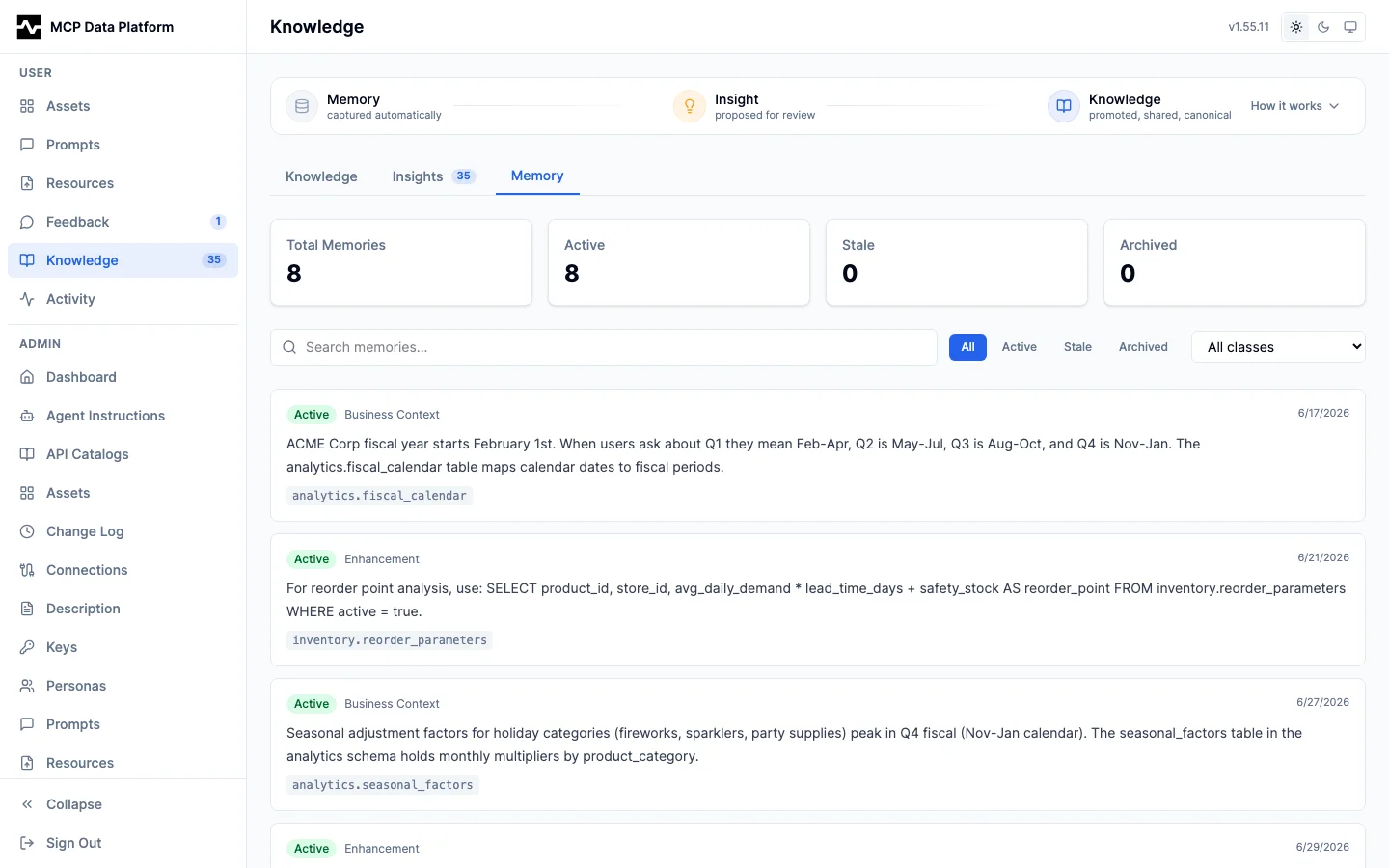
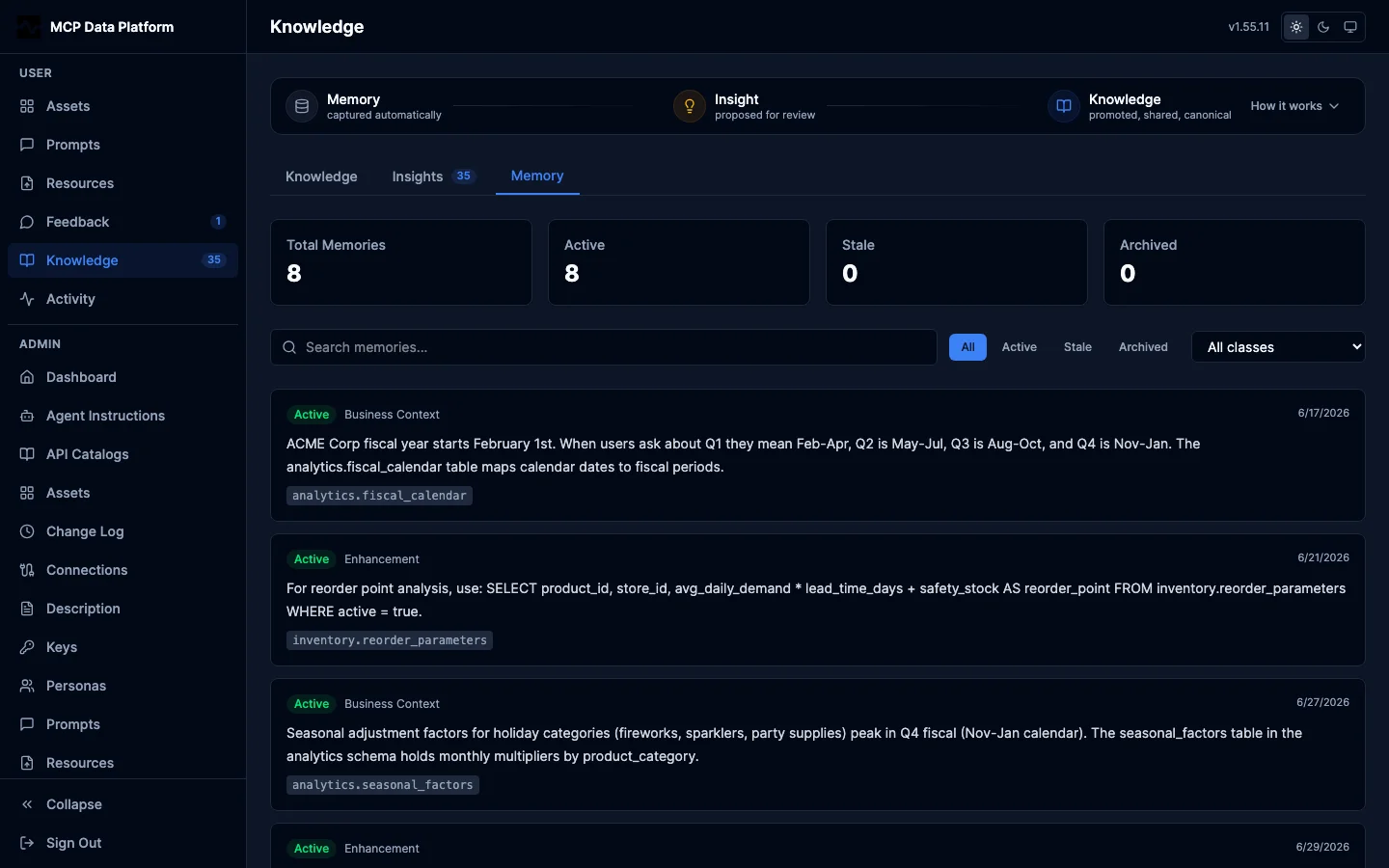
The portal lists what has been captured under Knowledge > Memory: counts of total, active, stale and archived records above a searchable list, each record carrying its state, its category, and the entity it hangs off.
Memories are classified by LOCOMO dimension for structured retrieval:
| Dimension | Purpose | Examples |
|---|---|---|
knowledge |
Factual/institutional | "We have two distinct selling seasons", "Test stores 9001-9099 are training environments" |
event |
Temporal/episodic | "On March 15 the analyst ran a Q1 sales rollup filtering out test stores" |
entity |
Entity attributes | "The customer_id column contains PII", "This table was migrated from Oracle in 2024" |
relationship |
Links between entities | "acme_legacy_sales is deprecated in favor of elasticsearch.sales" |
preference |
User preferences | "This analyst prefers SQL over natural language queries" |
Scoping
| Axis | Field | Purpose |
|---|---|---|
| User | created_by (email) |
Ownership. Users can only update/forget their own memories unless admin. |
| Persona | persona |
Visibility. Memories created under a persona are visible to that persona. Admin sees all. |
Tools
memory_capture
The one way to create a memory record. Routed by type (sink-class): personal_preference and episodic_event are live for the capturer immediately; business_knowledge, schema_entity, and operational_rule are recorded as pending insights reviewed via apply_knowledge.
Capture is recall-first, and it never waits on the embedder. The record is stored and returned at once, and its embedding is queued as a background index job (#1987). A slow embedding provider used to hold memory_capture open for minutes after the write had committed, so the client timed out and retried a capture that had been stored. When the job writes the record's vector, the recall check runs against the caller's records. Superseded rows are excluded from matching (a dead predecessor must not absorb a new capture's supersede); stale rows remain matchable, since a restatement is exactly how a stale record gets corrected. Of two records at or above the supersede threshold (0.9), the newer supersedes the older, whichever of them is embedded first, so a newer capture supersedes every record it restates. When the capture names entities (entity_urns), only records sharing an entity can match, so knowledge about one table never supersedes knowledge about another. Records that are similar but below the supersede bar (0.75 to 0.9) are written to the new record's metadata as similar_existing (id and score), so the owner can decide whether to consolidate. The record's recall_check metadata reads pending until the check has run and done after. The capture response's recall_check field says pending when the check will run, or unavailable when there is no embedding provider, in which case captures simply append. memory_manage update works the same way: changed content is written at once and re-embedded in the background.
memory_manage
Lifecycle operations for existing memory records. Opt-in per persona (requires memory_* in tools.allow).
| Command | Purpose |
|---|---|
update |
Revise content, category, tags on an existing record |
forget |
Soft-delete (archive) a memory |
list |
Query memories with filters, persona-scoped by default |
review_stale |
List memories flagged as stale by the lineage watcher |
review_duplicates |
List the caller's high-similarity active memory pairs for consolidation review |
consolidate |
Supersede a duplicate record by the record kept (id = keep, duplicate_id = supersede) |
review_duplicates is the backstop for near-duplicates the capture-time recall gate missed (captures made before dedup existed, or pairs scoring below the auto-supersede threshold). It lists the caller's own active pairs at or above 0.75 cosine similarity, highest first: memory content is per-user, so the listing shares the ownership boundary consolidate/update/forget enforce, keeping every listed pair actionable. consolidate completes the loop, preserving the correction chain via metadata.superseded_by rather than discarding the duplicate; both records must belong to the caller and the record kept must be active (so the only live copy of a fact can never be retired behind a dead record). Requires the database-backed memory store with vector search.
The listing is summary-first and byte-bounded: each pair returns ids, similarity score, status, timestamps, owner, and a bounded content_preview (first ~200 characters per side) rather than the two full records, and the response never exceeds the MCP output budget. Read a record in full with fetch mcp:memory:<id> or memory_manage list before consolidating; the consolidation decision needs the preview plus score, not the full metadata payload.
It is not offset-paginated. The candidate set is small and score-ordered, and it shrinks from the top as you consolidate (a consolidated duplicate goes inactive and drops out of the active-pair scan), so positional offset paging over that moving set would silently skip pairs. Instead, review_duplicates returns the current highest-similarity pairs (at most limit, default 20), and when the byte budget or the page limit hides lower-scored pairs it sets more_pairs: true. The pagination is the review loop itself: consolidate the surfaced pairs and re-run, which always re-presents the current top pairs until none remain.
Recall (via search)
Reading memory back is served by the universal search tool, which federates memory alongside insights, the catalog, prompts, assets, API endpoints, and connections. Within the memory source it draws on several retrieval methods:
| Method | How | LOCOMO Dimension |
|---|---|---|
| Entity lookup | Direct URN match | Single-hop recall |
| Semantic | Hybrid vector + lexical ranking via pgvector, with automatic lexical-only fallback when the embedder is unavailable | Open-domain recall |
| Lexical | Postgres full-text keyword match (no embedding call) | Exact-term recall |
| Graph | DataHub lineage traversal + entity lookup | Multi-hop reasoning |
Hybrid ranking
The semantic strategy fuses two signals per record: the embedding cosine similarity and a lexical full-text match flag, blended as 0.6 * semantic + 0.4 * lexical. This mirrors the api-gateway ranking precedent and materially improves recall on identifier-heavy content (entity URNs, column names, error codes) where pure vector search underweights an exact token. The vector arm is backed by an hnsw ANN index on memory_records.embedding; the lexical arm by a GIN index on to_tsvector('english', content).
Graceful degradation
When no embedding provider is configured (or it is down), semantic recall no longer errors. It falls back to lexical-only matching and labels the response so the degradation is not silent:
{
  "strategy": "semantic",
  "ranking": "lexical",
  "degraded": true,
  "note": "embedding provider unavailable; results are lexical-only (exact-term matches), not semantic",
  "memories": [ ... ]
}
Lexical search also surfaces rows whose embedding is NULL (saved during an outage) that vector search would skip entirely. Every recall response carries a ranking field (hybrid, lexical, entity, or graph).
Embedding Backfill
Memory is a consumer of the shared index-jobs framework (source_kind = memory), the same backfill queue the api-catalog and tools corpora use. The synchronous embed on write is preserved (a just-saved memory stays immediately recallable), and a periodic reconciler converges the gaps it cannot cover off the request path:
- A memory saved while the embedder was down (
embedding IS NULL) is re-embedded automatically once the provider returns, with no manual re-save. - A provider model swap re-embeds rows stamped with the previous model (
embedding_modeldiffers from the current model). - The
memorykind appears on the admin Indexing dashboard with a real indexed/expected coverage ratio.
The write path stamps embedding_model and embedding_text_hash (SHA-256 of the content) alongside each vector, so a healthy row is never flagged as a gap and the worker's text-hash dedup skips re-embedding unchanged content.
memory_capture (knowledge sink-classes)
Writes memory records to memory_records with insight-specific metadata (suggested_actions, related_columns). Generates embeddings via Ollama when available.
Ownership is keyed on the user's email (created_by), the same key memory_manage uses and the one the portal scopes by, so a person's insights and memories share an owner and both appear under their My Knowledge view. Insights captured before this was unified were keyed on the OIDC subject; the 000056_knowledge_owner_email_backfill migration rewrites those rows to the email last seen for that subject in audit_logs (stashing the original in metadata.legacy_created_by so it is reversible). Rows with no audit mapping are left unchanged.
apply_knowledge (existing, refactored)
Reads from memory_records via an adapter. Promotes curated memories into durable knowledge in the platform catalog (descriptions, context documents, glossary terms, tags, structured properties).
Cross-Enrichment
The existing bidirectional enrichment middleware automatically attaches relevant memories to toolkit responses. When a Trino query, DataHub lookup, or S3 operation returns results containing DataHub URNs, the middleware recalls memories linked to those entities and appends them as a memory_context content block.
No explicit recall call is needed for this; it happens transparently on every enriched tool response.
Each rendered record carries the canonical reference the agent fetches the full record by, in the namespace fetch actually resolves it from: mcp:memory:<id> for a memory, mcp:insight:<id> for a knowledge-dimension record. Because this push path is persona-scoped rather than caller-scoped, it delivers other people's records and cannot know whose, so only an applied insight is given a reference — fetch serves an insight to its capturer or, once applied, to everyone, and a record that fits neither case is delivered with no reference rather than one that answers not-found.
An insight entry additionally carries a verifiable block naming the table and connection one query would settle its claim against, whenever the entity it is about resolves through the query provider — see Knowledge: delivered insights say when they are checkable.
Staleness Detection
A background watcher periodically checks active memories against DataHub entity state. When a referenced entity is deprecated or its schema changes, the memory is flagged as stale with a reason. Stale memories are excluded from default recall and surfaced via memory_manage(command='review_stale') for admin curation.
Correction Chains
When a memory is updated or superseded, the correction chain is tracked in metadata.superseded_by. This supports temporal reasoning: "X was said, then corrected to Y" has a clean signal path through the memory graph.
Relationship to Knowledge Capture
Memory is the universal store. An insight (captured via memory_capture with a reviewed sink-class) is a subtype of memory: one that may carry proposed catalog changes. But knowledge is broader than catalog mutations. Domain context like "we have two selling seasons" is institutional knowledge that does not map to a DataHub tag or description update. The apply_knowledge tool is where differentiation happens: it reviews memories and promotes the appropriate ones into durable DataHub entities.
Because knowledge capture now lives in the memory toolkit (memory_capture), it requires the memory layer to be enabled. Memory defaults on when a database is configured; setting memory.enabled: false disables capture entirely.